Zingeris: Lithuania is Paying a Price for Wanting to Turn Belarus Into Ukraine

This video has it all…

I have found a video on Politnavigator, that terrible Russian disinformation platform, which however happens to be more informative than your mainstream media. It features Lithuanian parliamentarian, Emanuelis Zingeris speaking to a Belorussian opposition figure. I translate what he says.

I would like to tell my Belarusian friend that there isn’t any relent in Warsaw or Vilnius. You know how much we are paying for this. Belarus, Lukashenko, the former president has given an order to remove all the transports, starting with Potassium, through Klajpeda. This is the closest port for Belarus, one third of all transports through Klajpeda are Belarusian transports, we have rejected those things too… And we are simply on the side of the Belarusian people and it costs us, we understand this, and I am glad our government has given a clear statement on this matter. We are on the side of reforms in Belarus, we support Mrs. Tikhanovskaya and we hope that the Belarusian people learn from the experience of Ukraine and adopts Ukrainian structural changes. How Ukrainian became todays Ukraine…

There are politicians, who are so deluded as to give Ukraine as an example. Ukraine is the poorest country in Europe; it has a civil war on its territory; the Russian language, which Zingeris uses to communicate to his Belarusian friend is not official there; millions of people are forced to emigrate in search of jobs and security (Lithuania experiences similar trends); opposition parties are being under legal harassment; TV channels are being closed; neonazis celebrate SS in Kiev…

Belarusians can be glad Bat’ka did not allow Belarus to become Ukraine.

The Creed of the Ukroeuropeans

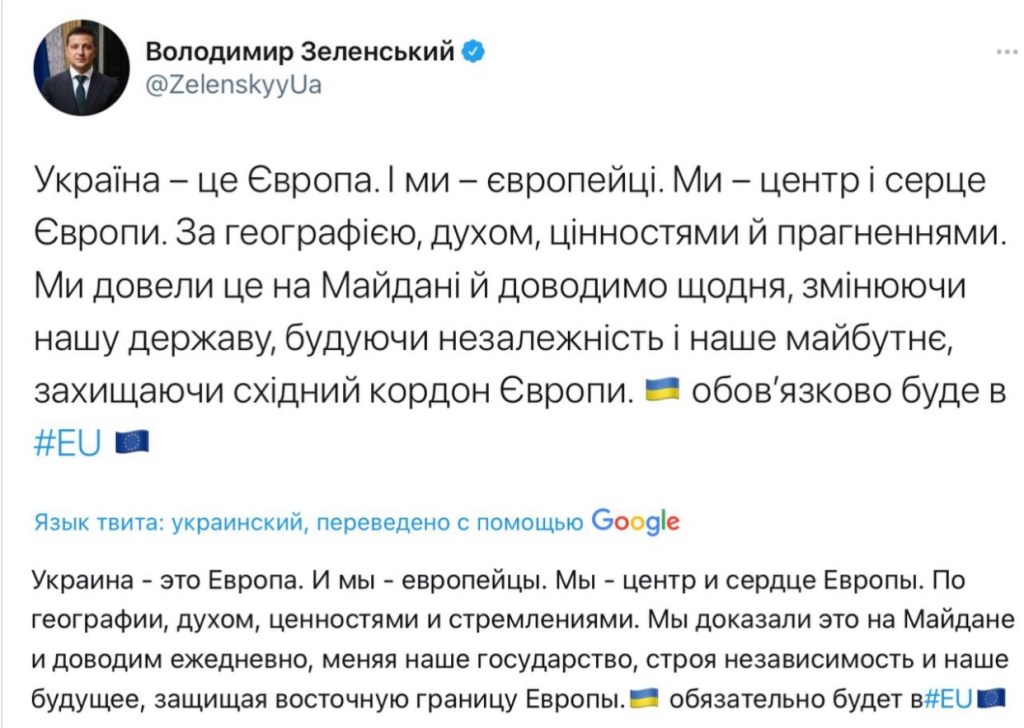
This tweet contains the entire mythology of the current Ukrainian regime…

Volodymyr Zelensky- the president of Ukraine

Ukraine is Europe and we are Europeans. We are the centre and heart of Europe. Geographically, mentally, through values and [our] aspirations. We have shown this at the Maidan and show this every day, by changing our country, building independence and our future, we are defending the Eastern flank of Europe. Ukraine will certainly be part of the EU.

***

Myth 1. Ukrainians are Europeans and have the same values. Neonazis do not have a free reign in Europe as they do in Ukraine.

Myth 2. Ukraine is defending Europe from the Russian horde. They actually believe this and repeat this every time they get a platform in Brussels or elsewhere. Ukraine is literally defending Europe by shelling villages in the Donbas. Who believes this?

Myth 3. Ukraine will become a member of the EU. Read this blog and you will know that it will not any time soon.

Ukraine Will Not Become a Member of the EU or NATO any Time Soon

Despite the wish of Ukraine to become a member of the EU and NATO being enshrined in the country’s constitution, the fulfillment of this wish may be further than some may hope…

It is unfortunate for the Svidomites, but 7 years after the signing of the Association Agreement between Ukraine and the EU, Ukraine is still not a candidate for membership. At the recent visit of US Secretary of State, Anthony Blinken to Kiev it became apparent the US gave a cold shoulder to Ukraine’s NATO aspirations. Rumor has it, Victoria Nuland told Zelensky to cool it with his NATO aspirations. Ukraine gets the same reaction from the EU. Ukrainian officials demand fruitlessly guarantees by the EU that Ukraine will one day become a member of the EU, and the EU does not give any such guarantees.

I may have mentioned it before on this blog but Ukraine, Moldova, Georgia are not targets of the EU expansion. Ukraine’s, Moldova’s, and Georgia’s situation is however further compounded by territorial disputes. It is clear that these disputes prevent the ascension to NATO for these countries but little less obvious is that these disputes prevent Ukraine from joining the EU as well.

And while, Transnistria does not have an armed conflict, and Abkhazia, and South Ossetia are quiet too, we hear almost every month about casualties in the Donbas. Donbas has a small intensity war. And while the other frozen conflicts can be mediated through the UN before the country ascends to the EU, see the case of Cyprus, the conflict in the Donbas would first have to calm down if Ukraine is to ever seriously consider an EU ascension.

Ukraine has a wretched economy. It is literally the extreme East of Europe and it closed its door to Eurasia. This does not bode well for any economic development. It is said Ukraine will reach economic parity with Poland in 40 years. Ukraine even lags behind any of the current candidates for EU membership. Economically, the Russian Federation has more chance of becoming a member of the EU than Ukraine.

Also consider that the Kiev regime is unwilling to fulfil its obligations under the Minsk Agreements. The current strategy of Kiev is to get the US, UK and Canada on board of the Minsk group. The continental guarantors of the treaties, that is Russia, France, and Germany would hardly find a common ground on this, and quite frankly affairs here on the continent should be delegated to continental powers.

The internal conflict, the bad economic configuration, the unwillingness of Kiev to resolve the conflict in Donbas, and the expansion plans of the EU, all postpone the Ukrainian ascension to the EU by many decades. The EU may even disintegrate before Ukraine even manages to become a candidate for membership, Ukraine may disintegrate too. The Ukrainian politicians should stop using the EU and NATO as their ideological mantra because the goals are improbable.

Poppycock

After the victorious Maidan, then president of Ukraine, Petro Poroshenko introduced a new tradition in connection with the Victory Day, which is on the level of Prince Philip cargo cults somewhere in the Pacific. They started to wear poppies, and Zelensky seems to continue this “tradition”.

British readers may be familiar with poppy wearing because it is worn to commemorate the fallen in the First World War in UK. The Ukrainian poppy is worn on 8 May, the day victory in the Second World War is celebrated in the West. The Victory Day is celebrated on the 9 in Russia and was celebrated on the 9 in Ukraine too until recently.

Or rather it is worn by government flunkies because by far not everyone has accepted this new idiocy and some mean individuals have even called it “ochko bandery“ – Bandera’s anus…

The Two Challenges of Ukraine

Secretary of State, Anthony Blinken identified two challenges of Ukraine…

“Ukraine faces twin challenges — aggression from outside coming from Russia, and in effect, aggression from within coming from corruption, oligarchs and others who are putting their interests ahead of those of the Ukrainian people,”

The problem is, Ukraine was created as a country for the oligarchs and by the oligarchs. If Ukraine was a country by the people and for the people, it would be a federation and would be friendly to Russia.

Neonazis Vandalize The Office of the President of Ukraine

This is what the door to the office of the president on Bankovaya street in central Kiev looks like now…

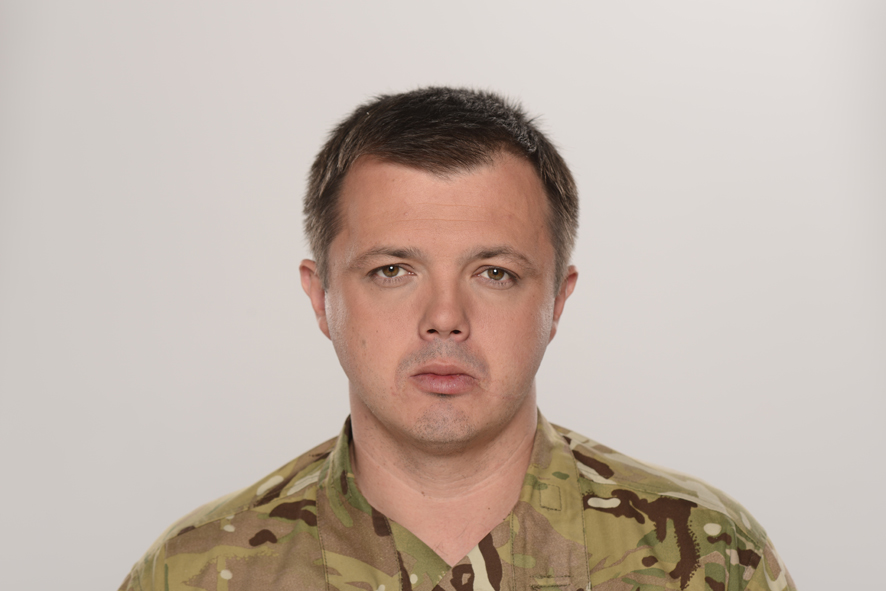
The neonazis have protested the jailing of a neonazi thug, Sternenko. But I am rather worried about a regime that allows the mob to vandalize seats of authority like this. The response of Murica to a rampaging mob was to call in the military to Washington DC.

So what will be Zelensky’s reaction to this?

China Sent a Business Delegation to Crimea

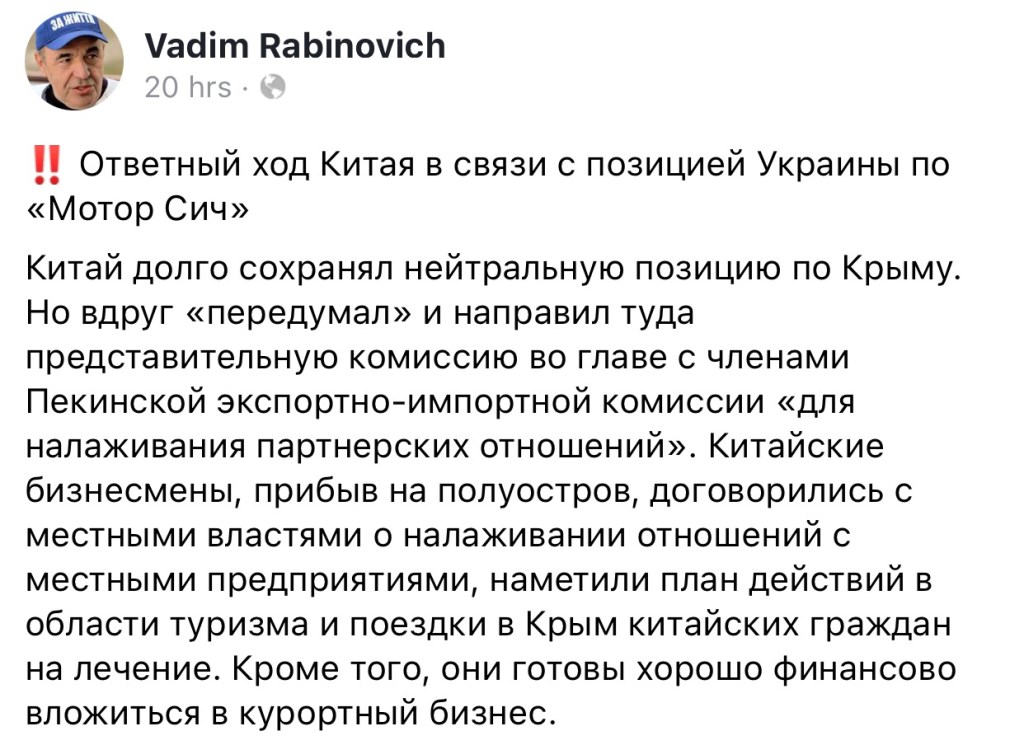
Ukrainian Member of the Rada, Vadim Rabinovich wrote the following on his Facebook:

China’s reply to Ukraine’s stance on the “Motor Sich”.

The Chinese have long maintained their neutrality on the issue of Crimea. However, they have suddenly “changed their mind” and have dispatched there a representative committee headed by the members of the Beijing Export-Import Commission to “establish partnership”. The Chinese businessmen have, together with local authorities, agreed to establish contacts with local companies, they have presented an action plan in the area of tourism and health tours for Chinese citizens. They are also ready to invest in the hotel industry.

***

RIA Novosti reports the Crimean Minister of Economic Development confirmed a visit of Chinese businessmen took place.

Motor Sich is a Ukrainian factory that makes engines for airplanes. A large share in the company was recently sold by its private owners to Chinese investors. The Ukrainian government, likely under pressure from America, sanctioned the Chinese investors, and said this is a matter of national security.

It begs a question, whose national security? Ukraine’s or America’s? The governments of the East European countries seem to have made American economic and security issues their own. A perfect colonial relationship.

Facebook Blocked A Russian News Story About Arrested Ukrainian Nazi Partisans

Three neonazis in the Russian city of Voronezh were arrested by the police for spreading hateful propaganda…

However, a report about them in the Russian media was censored by Facebook because it said the radicals had links to Ukraine. They were basing this claim on information provided by an insider in the security forces. Facebook has blocked the Russian media report after an analysis done by their Ukrainian fact checkers, the Stop Fake group. I have already featured them on this blog once. Their integrity is impeccable.

The Stop Fake argues that in the official press release of the Investigative Committee of the Russian Federation, there isn’t anything said about Ukrainian affiliation of the arrested, and that they were all Russian citizens. This however does not mean anything. It has to be noted that following the Maidan and the outbreak of military conflict in the Donbass, many Russian Neonazis, literal Hitler worshipers, went to exile to Ukraine because over there they can practice their love for Hitler without repercussions.

I have recently found, for instance, this Neonazi Black Metal group which migrated from Tver, Russia to Ukraine. They recently held a concert in Kiev.

Many of these types have served in Ukraine’s armed forces and they have veteran organizations. My knowledge about them only scratches the surfaces, the topic of Russian neonazis in Ukraine’s forces is a topic for a separate discussion.

But bottom line is that there aren’t just links between Ukrainian and Russian neonazis and an existence of a neonazi group in Russia with contacts in Ukraine is not something implausible.

Links of Stop Fake to Neonazis

Recently, the Ukrainian Soros funded publication Zaborana mentioned some cozy relationships between representatives of Stop Fake and radical nationalists:

One month earlier on June 2nd, Zaborona’s official Facebook page shared a publication about Denis Nikitin, a key figure among European ultra-right radicals, which the social network then blocked 18 hours later. Soon after, Facebook explained that the post was removed by mistake (assumingly, due to a photograph illustrating the material, in which a Ukrainian man wrapped in a swastika flag throws his hand in the Nazi salute) and reinstated it the next day. Zaborona decided to follow up on the incident and later released the material discussing alleged links of the fact-checking project StopFake to Ukrainian far-right and neo-Nazi organisations. Zaborona journalists explained their interest by the fact that after the removal of the Facebook post, some readers recommended to search for possible motives of the new fact-checking partner of Facebook in Ukraine– StopFake.org. On March 27th, Facebook indeed confirmed its partnership with StopFake and VoxUkraine to increase its fact-checking capacities on social network pages in Ukraine.

Zaborona eventually released material that first focused on Yevhen Fedchenko – the co-founder and chief editor for StopFake and director of the Mohyla School of Journalism at National University of Kyiv-Mohyla Academy. It pointed out Fedchenko’s habit of taking political stances, speaking against freedom of the press and on one occasion even whitewashing the reputation of a Ukrainian far-right group C14 (Sich), Ukraine’s controversial group of far-right radicals, by singling out one of its members as his respected colleague. Fedchenko has also been accused of taking the side of Myrotvorets, or Peacemaker, a Ukrainian nationalist website that in 2016 doxed the personal data of more than 5,000 Ukrainian and foreign reporters with press passes issued by the Donetsk and Luhansk People’s Republics, labeling them “terrorist collaborators”. A closer look, however, reveals that Zaborona’s allegations seem to be taken out of context and might conceal more complex motives in explaining such statements.

Later the Zaborona report moves on to Marko Suprun, “the main face of StopFake” and the person in charge of the English-language StopFakeNews project on YouTube. According to Zaborona’s findings, Suprun has often been spotted in the company of Ukraine’s infamous far-right figures, notably Arseniy Bilodub, the founder of the far-right clothing brand SvasStone and the leader of the hatecore band Sokyra Peruna, and Andriy Sereda, the frontman of another controversial rock band Komu Vnyz. The material refers to photographs of Suprun spotted together with both Bilodub and Sereda, as well as other Ukraine’s far-right radicals, and cites the opinions of experts, who point out that StopFake has become “too politicised,” and that Marko Suprun’s friendship with the extreme right may affect the organisation’s image.

Source

Yevhen Fedchenko blocked me on Twitter after I shared information on Jakub Janda to him. Marko Suprun is the husband of the Ukrainian-American, former Minister of Health of Ukraine, Ulyana Suprun. I am not surprised a Ukrainian-American would hang out with neonazis since many of them are descended from fugitive Nazi collaborators, who were given shelter by the CIA as useful assets in the fight against the Soviet Union. It is without question that having not undergone any denazification, these people still adhere to radical nationalist ideals.

Earlier on this blog, Facebook hires a member of a radical nationalist party to police its website.

Meanwhile, EU vs. Disinfo is trying to say the information that information regarding Neonazis moderating Facebook is disinformation of the Kremlin and says there isn’t any evidence to make this claim. Nothing new, this blog already reported on instances of apologetics for Neonaziism in Ukraine made by that website.

There isn’t any Space for Holodomor Propaganda in Russian Donbas

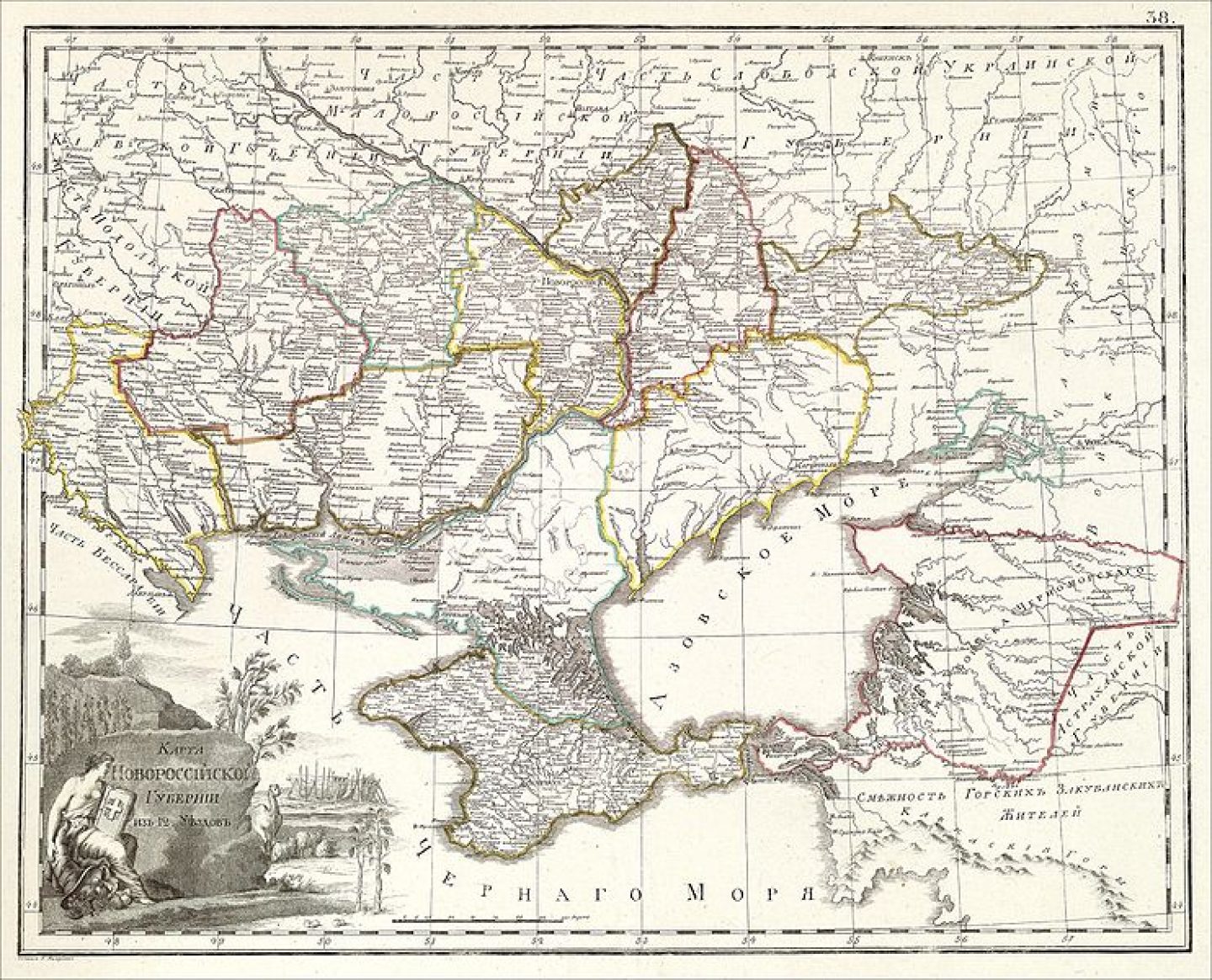
So I ventured to the Atlantic Council and found an article discussing a recent forum held in Donetsk called Russian Donbas, where the head of RT, Margarita Simonyan called for Donbas to be reintegrated with Russia…

There some Lithuanian Russophobe discusses the doctrine of the Russian Donbas, which is the intellectual blueprint for the aims of the Donbas republics, which is the reintegration with the motherland. There he writes:

The Russian Donbas doctrine is the latest example of the Kremlin’s enthusiasm for rewriting history in order to suit its contemporary political requirements. This tendency to distort the past has been central to the information war that has accompanied Russian aggression against Ukraine.

Well, OK…

When Russian forces first seized Crimea in spring 2014, Moscow propagandists were quick to declare that the Ukrainian peninsula had “always been Russian.” In reality, Crimea is an ancient land with a recorded history stretching back almost three thousand years that includes extended periods as part of the Byzantine Empire, Golden Horde, and Ottoman Empire. Meanwhile, Russia’s involvement in Crimea began comparatively recently in the late eighteenth century. Clearly, it is nonsensical to claim that this highly cosmopolitan geopolitical crossroads has “always been Russian.”

Please show me any academic Russian historian that made the claim that Crimea was always Russian. If anything, Crimea was a territory transferred from the RSFSR to Ukraine by the Bolsheviks, who have created Ukraine as we know it. I understand that in the Atlantic Council they prefer narratives that would derusify the Russian history of Crimea.

Regardless of whether the authors were Ukrainian, Russian, or Western, most traditional academic histories of the Donbas have tended to focus on three key aspects of the region’s early development. These accounts typically begin with details of how the Donbas was first colonized by Ukrainian Cossacks and peasants, who moved into the borderland regions previously known as the “Wild Fields” following the gradual retreat of the Crimean Khanate.

Next came waves of colonization from different parts of Europe and beyond. This was followed by an extended period of intensive international involvement that fueled the industrialization of the region throughout the second half of the nineteenth century.

Western investors and industrialists were instrumental in the development of the Donbas, bringing vital capital and technologies to the region. The most famous of these was Welsh businessman John Hughes, who founded Donetsk in 1869. The city was called “Hughezovka” in his honor until 1929, when it was renamed “Stalino” by the Soviet authorities.

The Russian Donbas doctrine outlined in Donetsk on January 28 made barely any mention of these crucial factors in the history of eastern Ukraine. Instead, the discussion focused almost exclusively on Russians who played prominent roles in the region’s growth.

The Ukrainian Cossacks and peasants did not have any notion of being Ukrainian. They thought themselves as Orthodox Russians. The region was always international and Russian was the lingua franca that served the people as means of interethnic communication, and the Russian people are an amalgam of ethnicities united by loyalty to the Russian state and the Russian language. Ukrainians on the other hand are an ethnographic subgroup of Russians that aims to build a separate nation and state.

There was no mention of the systematic Russification policies adopted during both the Czarist and Soviet eras, and no room for an honest exploration of the Holodomor, the artificial famine engineered by the Soviet authorities in the early 1930s that killed millions of Ukrainians and ravaged the region. Other Soviet atrocities were similarly ignored.

However, forum delegates did find time to condemn the Ukrainian authorities for recent efforts to return historical names to towns and cities throughout the Ukrainian-controlled areas of the Donbas. This was portrayed as evidence of the Ukrainian government’s anti-Russian policies.

Kremlin efforts to criticize the Ukrainian authorities for the “Ukrainianization” of Ukraine speak volumes about Russia’s deeply entrenched imperial thinking. This kind of ideology has roots stretching all the way back to the Czarist past, an era when Ukrainians were branded “Little Russians” and their language was suppressed as a mere dialect.

The only systematic nationality policy in Ukraine was Ukrainization under the Soviet union, which was presented in waves because Ukrainization always finds resistance from the people. The Russification of the late Tsarist era also came in waves because it encountered resistance in Central and Western Ukraine but it was much less systemic. Obviously, there is no way a Russian patriot would be interested in some Ukrainian nationalist bleating about how bad Russians Russified Ukraine.

Now, the author does show an absence of knowledge of Ukraine. the region itself was only joined to Ukraine by Lenin. It had nothing to do with any Ukrainian state prior to that and the names of cities all appeared during the Late Tsarist and Soviet eras. They either bear the names of the early settlers, communist revolutionaries, or something unrelated to Ukraine. For instance one village was called Novgorodske, and was given back its old name New York, which was probably a remnant of the early British colonization of the region but was renamed in 1951, right at the start of the Cold War. I don’t know where you see Ukrainization in the decision to give this town its old name, not even Ukrainization in inverted commas.

I am glad that the people of East Donbas are free from Holodomor propaganda because Holodomor is hateful hype of anti-Soviet forces. You see, the famine of the 1930s is a real event but Holodomor is something else, it is a spin on that event. In that interpretation, the famine was engineered by the Soviets to kill Ukrainians, and in the modern interpretation Russians are blamed for it. It first appeared in the press of Nazi Germany, which had a strong community of Ukrainian exiles from the Skoropadsky regime and was coaching Ukrainian nationalists to fights against Poland and the Soviet Union.

The story about the artificial famine was widespread in Western Ukrainian circles before WWII and that is why today, we see more people in Western Ukraine believing in Holodomor than in Eastern Ukraine where it actually happened. When I asked my relatives if my great grandmother, who was a Ukrainian peasant, ever spoke about Holodomor, knowing she was no fan of the Soviet government, I was told that she never did. She only complained about being made to work in a collectivized farm. She was not subjected to Holodomor propaganda. Famine was something that she experienced thrice, during the Civil War, during 1930s, and in the 1940s during WWII. My grandfather had to leave Ukraine and fend for himself after the War, he joined the military and moved across Russia.