Anal Pains From Russian Imperialism

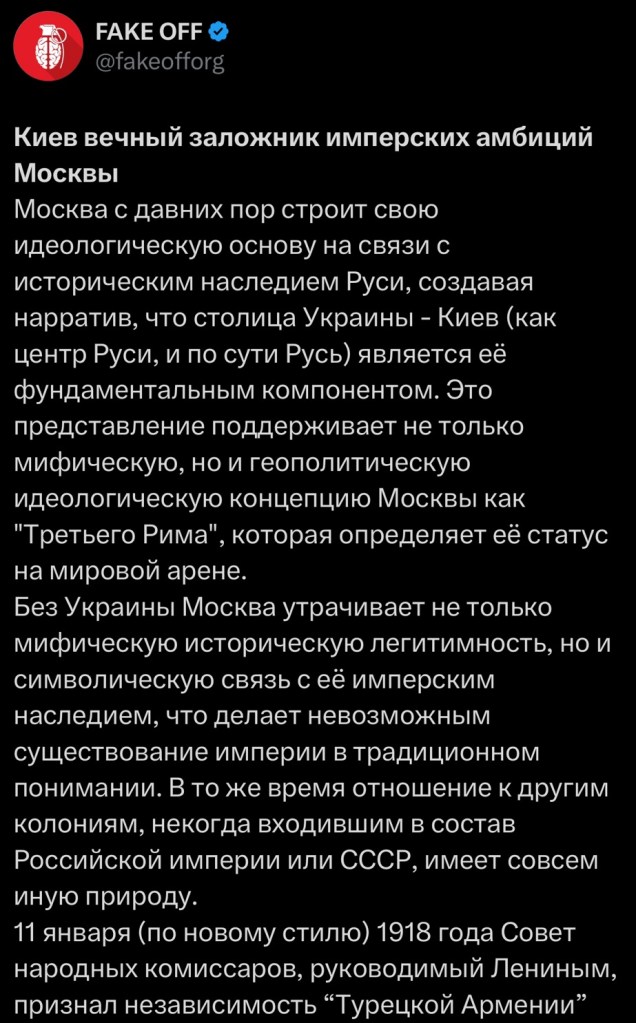
Kiev is the perennial hostage of Moscow’s imperial ambitions.

Moscow, since a long time, constructs its ideological foundation on the connection to historical Rus’, creating a narrative that the capital of Ukraine – Kiev (as the center of Rus, and essentially Rus) is its fundamental component. This imagining supports not only the mythical but also ideological concept of Moscow being the “Third Rome” which determines its status on the world stage.

Without Ukraine, Russia loses not only mythical historical legitimacy but also its symbolic connection with its imperial legacy, which makes the existence of empire impossible in the traditional sense. At the same time, attitude to other colonies once within the Russian Empire and the USSR is completely different.

11 January 1918, the People’s Commissar Soviet, headed by Lenin, recognized the independence of “Turkish Armenia”…

***

I love this borscht composed of outdated ideological concepts and anal phobias of the Russophobes. Let’s analyze them. Ukrainians actually think Russia is illegitimately called Russia, and the classic concept of Russian history from the Kievan period to the Moscow period is somehow wrong. They actually think Ukraine is something ancient, which it isn’t. Strangely enough, contemporary Russia was totally OK about Ukraine being Ukraine. Ukraine however turned out to be an anti-Russia. Ukrainian nation building is basically an exercise in the rejection of Russianness. Ukrainian nationalism glorifies traitors like Mazepa and celebrates anything anti-Russian. Therefore, the Russians stuck to the conception that was common and the Ukrainians try to torpedo it.

The Third Rome has to do with the Rurikids being related to the last ruling dynasty of Byzantium, the Porphyrogenites. The Grand Price adopted the title Tsar, and claimed to be the continuator of Rome after Byzantium. In the Middle Ages, this was nothing uncommon. Nobody outside Russia really cared about Moscow’s claim. And I don’t see anyone bringing it up now. This is Ukrop anus anguish.

Russia is not an Empire without Ukraine is a trope brought to us by Zbigniew Brzezinski, who had smelly Polack rectal sensitivities over Ukraine and Russia. Indeed, Putler needs Ukraine because he wants to crown himself emperor of the Third Rome. 😆 You know some people say Russia already is an Empire without Ukraine and needs decolonization.

I also see another ass bleeding in the text above. The other Soviet republics were not colonies of Russia. Without the USSR’s good will, there would probably not be places like Kazakhstan or Azerbaijan. Ukraine would probably would not exist as we know it without Soviet Ukrainksation. Ukrs never cut the USSR any slack. Instead, they adopted the post-colonial discourse from Western universities.

“Western Armenia” the issue was dealt with by Yosif Stalin. The territories which we are talking about were occupied by the Russian army during WWI, and were supported by local separatist movements. In this case, these were Ottoman territories, which made their recognition a matter of temporary tactical courtesy than a strategic choice.

The Bolshevik approach to the national question in the beginning of the twentieth century was pragmatic. The recognition of Polish, Finish independence, and the independence of many others was not motivated by a genuine support for the right of nations for determination but rather by political expediency. In the case of Poland, this direction was already marked by the Interim Government and the Bolsheviks did not see a reason to correct it. Finland because of its political maturity and readiness to resist also found itself outside the orbit of the Bolsheviks.

However, Ukraine always had a special meaning for Moscow. Its historical role in the formation of the Russian state, its natural resource potential, make it impossible for Moscow to see it…

***

Finland got independence pretty much with the abolition monarchy in Russia. It existed as a land governed by Nicholas II, not as Russia proper. It had its own laws, its own parliament etc. Poland’s rights have been curtailed after several Polish uprisings in nineteenth century but it existed in the shadows, and the Russians never considered it to be part of Russia.

Vladimir Lenin was completely pro-Ukrainian and he viewed Ukraine as an unfortunate victim of Russian imperialism, and deserving of independence. Lenin even acquiesced to the Brest-Litovsk accords and allowed the occupation of Ukraine by the Central Powers. He betrayed his fellow Communists in Donetsk-Krivoy Rog Republic. However, the civil war in Ukraine was very much a fight between local Bolsheviks and the Ukrainian People’s Republic under Hrushevsky and Petlyura. Contemporary Russia was also cool with Ukraine until it became anti-Russia in 2014.

Hence, having anal pains over Russian attitude towards Ukraine is kinda misplaced. Not so long ago, Ukraine was Russia, and the Ukrainians were Russians. Hence the Russians are only reacting to the teleological development of the Ukrainian project into anti-Russia. The Russians have very little issue with friendly and brotherly Ukraine, and accept its existence.

…as a region that can be divided from the empire. A complete, organic, national identity of the Ukrainians that is developing separately from the imperial “Russian” completely undermines the foundations of the “Third Rome”. This is why Moscow’s propaganda machine is building narratives about the “triune nation” and “historical commonality”, categorically denying the right of Rus Ukraine to its separate history and independent future.

If we compare this approach with the acknowledgment of the independence of the “Turkish Armenia”, we need to point out that this territory has never been part of the internal core of Moscow, and its strategic importance was only within the frame of a temporary military-political context. The recognition of independence had the character of a diplomatic move and not the reflection of an imperial necessity.

An important factor is also how Moscow uses historical myths. In the case of Ukraine the basis is formed by the mythical “Old Rus”, which is said to be the source of the Russian statehood. At the same time in the case of other territories there aren’t these deep symbolic connections. That means that the destiny of “Turkish Armenia” or even…

***

The author refers to Russian historical concepts as myths but talks about so called “Rus Ukraine”. Rus Ukraine is a concept invented by Ukrainian nationalists to link Old Rus history to Ukrainian reality of today. Ukraine however was referred to as Rus, or Russia Minor not so long ago, and the name Ukraine was adopted for the nationalist project under the influence of the poems of Taras Shevchenko, and with support of the Austrian government, somewhere in late nineteenth century. The name was originally used in the context of Shevchenko’s home region in the Central Dnieper region. The Austrians were actually interested in changing the identity of its own subjects

If it wasn’t for failure of Russia in the Great War, this bullshit conception wouldn’t ever succeed, and poison the minds of people into the twenty first century. Ukrainians need anti-Russian mythology to justify their very existence. If faced with reality instead of their propaganda, they become Russians. The former minister, Dmytro Tabachnyk and the writer Oles Buzyna were Russians although they were more Ukrainian than many Ukrnazis. Russianness is high culture, Ukrainism is militant provincialism.

…such important regions such as Poland or Finland, would be decided depending on the current situation, while Ukraine was always at the centre of imperial ambitions. Today’s discourse of Moscow demonstrates lack of change in this approach. In the conditions of today’s World, where empires do not have the same legitimacy as before, Moscow continues to cling to the past, preserving the illusion of historical right to control over Ukraine. However, the historical paradoxes show that if a country tries harder to hold on to what was lost the faster it loses its future.

***

I personally believe that much like Lenin accepted the occupation of Ukraine by Central Powers, the current Russian Federation did accept the loss of Ukraine in the nineties. But given the similarities between the two countries, and a strong Russian element within Ukraine, the countries were bound to come together. Much like the Ukrainian Bolsheviks came to accept Moscow, the Russian Federation found willing collaborationists in contemporary Ukraine. Particularly in Donbas and Crimea. It is not that Russia will lose Ukraine but that Ukraine and Russia are natural allies, and to this conception is opposed Ukrainian nationalism that not just asserts that Ukraine is not Russia but also that Ukraine belongs to another civilization and is antagonistic to Russia.

I personally think contemporary Russia never had any wish to claim the entire Ukraine. They never committed the resources, or did any actions that would suggest that. It could come to that if the Ukrainian resistance in Eastern Ukraine collapses but in that case, I still cannot see Russia occupying the entirety of Ukraine. In my opinion they should subjugate the entirety of Ukraine.

They literally included this AI picture of an Asian guy with a cross.

The Uniting Marker of Ukrainian Identity is Russophobia

What is the uniting marker of Svidomites – that is nationally conscious Ukrainians?

Those that read this blog know that I hold that the Ukrainians were once Russians, they are a nation created out of Russians with the help of enemies of Russia.

But in this post I will discuss the diversity of Ukrainians and what unites the Ukrainian nationalists. It is rather ironic that today we find Russian speaking Ukrainian nationalists, and even anti-Western Ukrainian nationalists. The ideal of a Ukrainian nationalist that is a Ukrainian speaker, wants to join the West, and is a Ukrainian Catholic or Ukrainian Orthodox, which is cultivated by the contemporary Ukrainian state is not shared by everyone.

In the East of the country, there are those that still prefer speaking Russian. While some have been mentioning how they switched to Ukrainian when Russia invaded, this is nothing but virtue signaling, and is not shared by everyone. Ironically, switching from Russian, which was your mother tongue to Ukrainian is in itself an act of Russophobia. It is basically switching to someone you are not naturally.

Even though there has been a lot of pressure put on the Ukrainian Orthodox Church, which maintains spiritual links with the Moscow Patriarch, I am not certain how successful it was. Clearly, religion cannot be the defining factor common to all Ukrainian nationalists. Many hardcore Ukrainian nationalists actually gravitate towards paganism and even satanism.

Not even the geographical or ethnic origin of the person is a defining characteristic of a Svidomite in this day and age. You have people of different ethnicities assuming the Ukrainian position, Jews, Koreans, Armenians and even ethnic Russians. Basically Ukraininism/Svidomism is not about your origins but rather your identification with the Ukrainian idea and that means the hatred of Russia because you cannot be pro-Ukrainian without it.

Russia is the other against which Ukraine defines itself…

Ukrainians Can’t Have the Cake and Eat it Too

I have noticed profound confusion in Ukrainian narratives, and you may have read many posts on this blog, where I discuss them…

Let’s start:

1) The Ukrainian nation is a modern nation, created on the basis of a vernacular language that developed in the East European plain through the contact of Old Russian peasants with their Polish overlords. 40% of Ukrainian are borrowings from Polish. It is precisely this centuries long estrangement from the rest of Russia that gave rise to the ideas of a separate Ukrainian nation.

Well, if Ukraine is based on a culture created by centuries of Polish rule, why then would the Ukrainians claim the legacy of Old Rus’. I get it, the true history of Modern Ukraine is the history of enserfed peasants, and there isn’t much to say about the place after the Old Rus’ perished in the flames of the Mongol invasion.

Ukraine is the only country of the East Slavs that does not contain in its name a reference to Rus’. Belarus and the Russian Federation do. Mind you, “Russia” is the hellenized form of the word Rus’ that entered World languages, and retrospectively the Russian language in the time of the Romanovs. I bet the Zmahars (Belorussian nationalists) would have changed the country’s name if a suitable nomenclature was current there.

So, if Ukraine on one hand is the rejection of Rus’, and commonality with Russia and Belarus. How then can Ukraine claim to be the sole proprietor of the Rus’ legacy? Ukrainian officials even make rather uniformed statements that the Russians, of the Russian Federation have somehow usurped the label Rus’.

2) Russian gas is very dirty, said Zelensky on one of his recent visits to the United States but Gazprom must continue pumping that gas to Europe because Ukraine needs the money. For many years, Ukraine was buying Russian gas through Slovakia which was several times more expensive than if it was bought directly from Russia. The Ukrainian population is feeling this independence from Russia every time they have to pay the bills.

3) Ukrainian officials speak of an ongoing war with the Russian Federation but neither is there an official declaration of war, there isn’t even a conflict going on Russian borders.

Ukraine signed the Minsk Accords but would not implement them in any form because then they would have to acknowledge that the Donbas is an internal Ukrainian conflict.

4) Speaking of Donbas and Crimea, the Ukrainians have for a long time used the question: “Whose is Crimea?” as a way to determine a friend or foe. But Crimea is a testament to the formation of the Ukrainian state.

You see, the country named Ukraine was entirely created by the Bolsheviks. The anti-Tsarist forces in the Russian Empire in the nineteenth century were very fond on the budding Ukrainian nationalists. Ukrainian nationalism in the late nineteenth century was very much intertwined with the ideas of social justice, it was about the emancipation of the downtrodden peasants, and naturally these ideas found favour with the Bolsheviks, and it was the Bolsheviks, who played the decisive role in the formation of Ukrainian state as we know it.

It was through the decision of Lenin that the Donbas became Ukraine. Stalin annexed the Western part of Ukraine from Poland and Czechoslovakia, and Khrushchev gave Ukraine Crimea. When Ukraine gained its independence in 1991, instead of trying to accommodate the people in the disparate lands they were given, the successive Ukrainian governments have embarked on a program of imposing what arguably is a West Ukrainian culture on the whole of the country.

The West Ukrainians have the desirable quality of being the most distant from the Russians but they also have a seething hatred towards the Bolsheviks that they view as occupiers. Stalin does not get any props for uniting Halychyna with the rest of Ukraine.

It is rather ironic that when the Ukrainian nationalists began toppling the statues of Lenin around Ukraine, Crimea and the Donbas seceded. You simply cannot deny the genesis of Ukraine in the USSR through the good will of Soviet leaders. The West Ukrainian nationalists have never fought for this territory, they haven’t spent a single bullet for this territory, they have inherited it from the Soviets.

Naturally then, if they want to claim this territory, they have to fight over it. But at present, Kiev finds the guts only to fight the separatists in the East, and therefore de facto, Crimea is Russia.

Recently, Russian rapper Morgenshtern, who arguably promotes a rather degenerate culture of American rappers but is actually smarter than he appears, said in an interview with the Ukrainian TV host, Dmytro Gordon that Crimea belongs to the Crimeans, and basically only the people of Crimea can decide which country they want to belong to.

5) Ukrainian officials claim they are defending Europe from the invasion of Russians from the East. They are probably trying to elicit the help of the countries to the West of their borders, who are no less sick with Russophobia than they are. However, do they not realize that their most immediate Western allies are in no position to help them militarily. The guarantors of the Minsk accords are France and Germany, not Poland and the Czech Republic. Moscow does not consider the latter as equal partners.

How the Union Leads to Ruin in Ukraine

The Uniate Church and the Ruin are two concepts from Little Russian history that inform the Ukrainian reality of today…

From the olden days, the Holy See in Rome sought to conquer the Holy Rus’. Alexander Nevsky had to repel an invasion of the Teutonic Knights but there was a much more fearsome foe than the knights, the Rzeczpospolita, the Polish-Lithuanian Commonwealth. Both constitutive realms of this empire began expanding their domains into Rus’ already in the fourteenth century with the seizure of Halychyna by the Kingdom of Poland. Coincidently, a gene test my brother did shows we are descended from the Lithuanians that conquered Rus’ and there is family legend about a “Polish” ancestry on my Russian side.

There was a difference in faith, while the Westerners answered to the Pope, Rus’ answered to the Eastern Churches and eventually, Moscow became free of Constantinople following the Ottoman conquest, and the only rightful spiritual authority in Rus’. Fearing this Muscovite influence, the Polish masters of Ukraine decided to bring the Orthodox Churches under Roman Catholic control. In 1595 at the Union of Brest, the bishops of Little and White Russia under Rzeczpospolita accepted Roman domination. Several decades have passed and a rebellion erupted in Little Russia, which saw the Cossacks swear fealty to the Russian Tsar. This has plunged Ukraine into a destructive period known as the Ruin, which resolved itself really only in the eighteenth century with the Russian Empire coming to dominate the entirety of Little Russia, and the neutralisation of the Rzeczpospolita.

But unfortunately, the Russian Empire failed to take Halychyna in the division of Poland. Halychyna, or Galicia as it is also known, is a part of Rus. West of Lvov, there lies a town called Rava Rus’ka, that’s where Rus’ begins and it goes all the way to Vladivostok. Halychyna fell under the Austrian rule, and the Uniate Church survived there. This later served as the nucleus out of which will rise Ukrainian nationalism. Starting in the second half of the nineteenth century, the Austria-Hungary, as the Habsburg realms came to be known, entered into alliance with the German Empire, the Russian Empire joined France in an Entente. The Habsburgs became enemies of Russia.

Maxim Sandovych

Austria was faced with a problem of Russians on its territory. The Austrians viewed so called Russophillism of many of the inhabitants of Halychyna with suspicion. Thousands of people from Halychyna made annual pilgrimage to the Pochayevskaya Lavra, an Orthodox monastery right across the border from Austrian Halychyna in the Russian Empire. The Austrian authorities began repressing the local Russophiles. Maxim Sandovych, an Orthodox covert from the Uniate Church was tortured to death by the Austrian authorities prior to the First World War. After the Russian defeat by the Central Powers in 1915, the Austrians have interned the Russian population in concentration camps in Terezín in Bohemia, and in Thalerhof in Styria. Wikipedia has this to say about Thalerhof:

The Austro-Hungarian authorities imprisoned leaders of the Russophilism movement among the Carpatho-RusynsLemkos, and Galicians; those who recognized the Russian language as the literary standard form of their own Slavic dialects and had sympathy for the Russian Empire. Thus, the captives were forced to abandon their identity as Russians and obtain a Ukrainian identity. Captives who identified themselves as Ukrainians were freed from the camp.

Terezín became the site of a genocide again during WWII, when the Jews were interned there.

Simultaneously with the repression, the Austrians have supported a development of a Ukrainian identity that would be different from Russian. Remember dear readers, national identities are always imposed from above and people can always be reprogrammed. Polish nobility long toyed with the Ukrainian idea. According to Mikhail Onufrienko, a blogger from Kharkov that now lives in Crimea in exile, the idea to rename the South Western part of Rus’ into Ukraine originated already in the sixteenth century with the Jesuit envoy, Antonio Possevino. Part of the reason the Polish rebellions against Russian rule of the nineteenth century failed was because the Russian peasants didn’t go along with their Polish masters. Many of these Poles and early adepts of the Ukrainian national idea fled to Austrian Halychyna, where they continued their work with Austrian support.

A good example of the Austrian support for Ukrainian nationalism is Mikhailo Hrushevsky, who was given a cushy job of a professor in Lvov and a hefty grant to write Ukrainian history, a historical conception that removes Ukraine from the common Russian history. If you were to write the true history of Ukraine, you would have to start with Nikolay Kostomarov, Ivan Franko, the afore mentioned Hrushevsky, and not somewhere deep in the past, like in the Cossack period. The Cossacks referred to themselves as Russians. I would not even speak much about Shevchenko, who also identified as Russian. But Hrushevsky did just that, relabelled them all as Ukrainians. I call the conception that Ukraine emerged out of Ukrainian nationalism, which was heavily supported by the enemies of Russia, “a short history of Ukraine.”

By the First World War, there was a sizeable community of newly created Ukrainians in Halychyna. The first time the nationality “Ukrainian” appeared officially was in 1916, when the future Emperor Charles I inspected the troops in Halychyna, and declared everyone in the camp to be Ukrainian. After the revolution in Russia, the Communists, who were opposed to Russian nationalism made the decision to break down the Russian nation by employing the Austrian project, and began a programme of mass creating the Ukrainians. For this purpose, they brought many teachers from Halychyna, including the aforementioned Mikhailo Hrushevsky. Russia’s Ukrainian headache is a bolshevik legacy.

Early Ukrainian nationalism was very much centred around the Uniate Church, the Austrians viewed the papists as loyal citizens. Ukrainism was therefore an extension of the previous Union, the Union of Brest. In more recent times an idea of a united Europe appeared, and since the 1990s, the European Union is bringing these ideas into reality. But parallel with the European Union that we all know from the European Parliament, and the European Commission, there is also a spiritual union and the ideological founder of European integration, the Pan-European Union.

The importance of union with Rome has slightly diminished in recent times with the decline of Catholicism and religiosity in the West, and the centre of control gravitated eventually to Brussels. However, there is a lot of “Habsburg” influence on the symbolic basis of the EU. You see, the Pan-European Union has given the European Union all of its symbols. The circle of twelve stars:

The twelve stars symbolise the twelve signs of the Zodiac, and the number 12 stands for completion and perfection. Note the Cross, as if indicating an inheritance from the Roman Catholic project. The secular EU, and the European Council of course do not have the cross in their flag. Furthermore, the anthem of the European Union, the Ode to Joy, was adopted by the Parliamentary Assembly of the Council of Europe in the 1970s on the suggestion made in 1955 by Richard von Coudenhove-Kalergi, a son of a Bohemian Nobleman and an upperclass Japanese gaijin chaser, the founder and the first head of the Pan-European Union. Now check out the Ode to Joy on the Euromaidan, they even created new updated lyrics for it in Ukrainian. After Coudenhove-Kalergi, the head of the Pan-European Union was Otto von Habsburg.

Petr Fiala, the current head of the Czech Civic Democrats with Berndt Posselt, the current leader of the Sudetendeutsche Landsmanschaft, and Otto von Habsburg at a Pan-European meeting in Moravia. Habsburgofilia is strong for some reason in the Czech Lands.

It seems like the Austrian nobility found itself a new tool of domination. They have switched Catholicism for European integration. Ukraine suffers a new period of strife currently, Ruin 2.0, caused by a desire for another Union, as expressed in the Cargo Cult festival, the Euromaidan. Ukrainians seem again victims of some Austrian voodoo. And the EU is not even able to make Ukraine a candidate for membership.

Don’t be a cuck, don’t fall under the spell of an Austrian voodoo. Although, I have to say many adepts of Ukrainism are also adepts of another Austrian voodoo, created by the arch-opponent of Coudenhove-Kalergi.

Give the Eastern Slavs USSR 2.0

I don’t have the old sovok in mind. I mean a Union of Slavic States of the Rus…

Ahead of time…

The Eastern Slavs deserve an Empire with outposts in the Carpathians. This ideology presupposes the rejection of any propositions that do not lead to the unity of Eastern Slavs. Disunity and regional separatism is nothing but a method of the Collective West to weaken Russia and exploit its territory.

Anything that opposes the unity of Russia is actually a tool of the West to be used against Russia. The Ukrainian nationalism is a decrepit ideology of Petlyura, Bandera, Shukhevych, pogroms, Babiy Yar, Khatyn’, The Odessan House of the Trade Unions. It is an evolutionary dead end. The Ukrainian nationalists haven’t won any of their territories and must give them back to the Russian people. Ukrnazis can relocate to Canada for all I care.

The Russian Federation and its ally Belarus must work out a way to neutralise and topple the regime in Kiev and install somebody that would realign the country East. An ideology of unification needs to be worked out.

New Ukraine will have:

  1. Russian made official on the entire territory.
  2. Trade Union with the Russian Federation and Belarus.
  3. Ukrnazis and any forms of Hitler onanism will be banned and Ukrnazis will be expelled to the West.
  4. That includes a total ban on radical Ukrainian nationalism, that means Bandea, Shukhevych, Petlyura were all ghouls.
  5. Russophobia will be punished with prison.

I believe that the above is achievable in our lifetime. Russia, Belarus, DNR and LNR should work in concert to neutralize Banderstan. Banderstan is now almost surrounded, and I am not certain why Moscow, Minsk, Donetsk and Lugansk let it live?