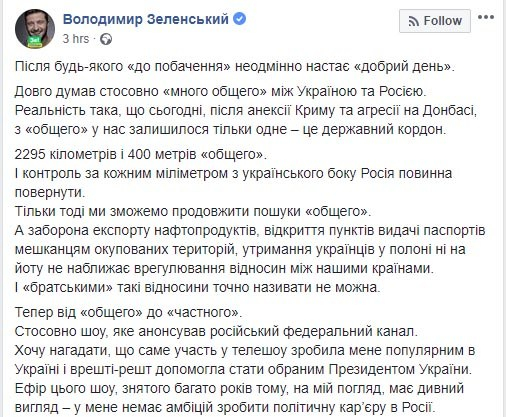
A Facebook Friend of mine got Blocked for a 2014 Post

I translate:

56505422_2208022046193649_2162025054349557760_n.jpg
The situation with mobilisation -I just spoke with a relative on the phone. He told me there are raids in Kharkov -the draftees are being mobilised out of shops and beaches. However, that’s not all. When you are dragged into the recruitment office, you are being offered to sign a document that you are a volunteer, and arrived there [voluntarily], and are ready to suffer all the miseries of the military service. (that is to be all in shite, in tents with holes, without food and ammo) If you refuse, you get smacked. Just like in the police station. The other option is 10 thousand hrn. that is a one time free card, they will let you go for now, and next time everything starts anew. Once again, the vast majority of supporters of the Maidan out of the “creative class” have documents relieving them of military service, and they are not rushing to join as volunteers. Another info from a man from Lugansk, who relocated his family to Crimea. Day before yesterday he took the grandsons. The U#rs have taken all young men off the train. He wasn’t grabbed (he’s 56) but was told to prepare. Soon they will grab the elderly too. Glory to Ukraine, FUCK!
My friend was likely banned over calling Ukrainians “Ukrs”. His comment was likely found using a bot that sifts through posts. But who gave the order to find such comments were likely Facebook employees in Lvov.

Elena Bondarenko: The Russians took Crimea from the Americans, not the Ukrainians

This interview with the former member of the Ukrainian parliament, Elena Bondarenko, was published on the Czech news website, iDnes, in March. What is particularly curious about this publication is that iDnes is mainstream press in the Czech Republic. Bondarenko is not being usually featured in the mainstream media in Ukraine, or elsewhere with the exception of Russia, because of her stance…

images-6.jpg

Last week, (the interview was published on 3 March) five years have passed since the shootings at the Maidan. Deadly conflicts in central Kiev have taken dozens of lives. Elena Bondarenko, who was a member of parliament back then, offered her point of view to MF Dnes (iDnes is their internet representation). “The Maidan was a political Chernobyl”, says the woman, who leads an independent Center for Freedom of Speech, and who is invested in the issue of political prisoners.

What are your memories of the day when the shooting began at the Maidan?

[They are] terrible. I was in the government quarter, some 100 metres from the site of the shootings. I was talking to German journalists when it happened. At first we did not realise what is happening. Confusion has ensued, chaos among the policemen, who lacked commands what to do. Then buses have appeared and the commanders have boarded the policemen onto them, and drove them away. They wanted to protect their men. At that moment, a couple of policemen were already dead. I have only heard the news that the shooters aimed at the protesters too on TV, the second day.

Do you believe that the tragic events will ever be properly investigated?

Definitely not under the current regime.

Why?

Because it is being investigated by people, who have benefited the most [out of these events.] They are cynics. They pretend they are are investigating the deaths of the protesters but nobody investigates the deaths of the policemen! Meanwhile, in the last five years, several testimonies of armed men have appeared where they admit they have killed policemen. One of the is Yuriy Bubenchik. He walks free to this day.

I can’t believe somebody admitted to several murders of the policemen, and it was ignored by the state?

In Ukraine this is possible. The Maidan was a political Chernobyl. Right after the shooting, another crime occurred in the parliament.  It was the adoption of the amnesty law, which the organisers of the putsch pushed through on the second day under threats to the parliamentarians. They have forever rid themselves of the responsibility for dozens of crimes, including those of the worst kind. They have exonerated themselves from crimes such as the overthrow of the government, illegal usurpation of power, murders, robberies, occupation of state buildings and institutions, kidnappings and illegal arrests of people -and several other crimes.

You have been a member of the parliament back then. Did you vote for this law?

No. I was afraid like I never was in my life. They threatened my life, they threatened to kill my children, you cannot imagine how brutal was the pressure. But I did not vote for the law.

Who, in your opinion, gave the order to shoot?

I don’t know. First we would need to know the truth about who was shooting. we don’t know these people, and will not know, particularly those that shot from the buildings, which were controlled by the Maidan rebels, that is from the Conservatory and from Hotel Ukraina. How objectively do you think would the identity of the shooters be investigated, when the current speaker of the parliament led the protesters in Hotel Ukraina? It was simply a brutal anti-government putsch. But I realise that west of Ukraine’s borders, this word is not popular in political circles.

How do you explain this?

Simply! The West played a very malevolent role in this putsch. They have approved it and helped it. Before the shooting at the Maidan, things have been getting out of hand for the protesters. After the shooting, the organisers have quickly amnestied themselves. An agreement between the government and the opposition, which three Western politicians have guaranteed. Polish, French and German (the ministers of foreign affairs of Poland, Radoslaw Sikorski, France, Laurent Fabius, and Germany, Frank Steinmeier).

They gave guarantees to President Yanukovych that the agreement will be respected if he agrees to early elections. Yanukovych agreed. But the putschists immediately began ignoring the agreement, and the EU tolerated it. When Yanukovych realised that the guaranteed agreement was nothing but a piece of paper, he tried to contact all the mentioned guarantors and other European politicians. Nobody picked up the phone.

After which, he became afraid for his life. And the rest of the story is known -the East and Crimea did not accept the result of the unconstitutional coup. The betrayal of Yanukovych, the shootings, and the subsequent law of amnesty terrified them. The newly ascendant power made other grave mistakes, and thus provoked a civil war.

You have been the vice-president in the Committee for the Freedom of Expression and Information in Ukraine. You were the author of two laws about the freedom of speech and free access to information. Today, you are leading a Centre for the Freedom of Speech. What is the freedom of speech like in Ukraine?

There practically isn’t any.

But your laws are still valid, Ukrainian journalists work on their basis.

Formally yes, however, everything otherwise has changed. At least 10 journalist have been killed, the most significant were Oleh Buzyna and Pavlo Sheremet. These murders were never investigated. Other journalists are imprisoned. The offices of the opposition media, which are inconvenient to the current government, are being blocked, banned, robbed, burned, the journalists are being kidnapped, beaten… We know of black lists of journalists, media, social media accounts, but also of books, films, and music.

Who compiles these black lists?

The political section of the SBU. (the Ukrainian secret service) They monitor all the active and brave people, politicians, bloggers and journalists. They have the best equipment from the CIA, and receive training from the Americans in ways of monitoring the citizens. The servers, which store the information, including information gathered through wiretapping, are located in the US.

I see that you look incredulous, but that is not kept secret by anyone, the head of the SBU, Vasyl Hrytsak openly spoke about it. We don’t have any state secrets now, we share everything with the Americans. The government relinquished state sovereignty.

Do you talk about the murdered journalists with Western organisations?

Most of them are playing dead. Only Amnesty International and OSCE occasionally react. Two years ago, 13 illegal prisons were discovered in Ukraine, where the opponents of the current regime are held. All of them [are being held] illegally, they have been declared missing.

There will soon be elections in Ukraine. First presidential, and then parliamentary. Do you have a chance to change this?

Do you think so? Yes, dictator Poroshenko led the country so badly, he now has little chance to be reelected. But I am afraid that he may provoke some incident, create a situation, where he could declare a martial law and use the military.

Dictator? Dictators normally do not expose themselves to free and democratic elections.

And who told you the previous elections were free? And even the current elections will not be free. Already the now, the campaign is being led unequally. I spoke about murders, imprisonments, threats to journalists, looting and arsons of offices of the press. Oppositions are readily attacked, beaten, sprayed with acid.

All major media are controlled by the state. A ministry of propaganda was created, officially it is called Ministry of Information. They decide, which media are good and which are bad, who will lose his license. [Marina Poroshenko, the first lady, is the godmother to the minister’s daughter.] The members of the electoral committee are a joke. Two thirds are personally dependent on Poroshenko. There isn’t a single representative of the opposition in the commission. The president of the commission is Mrs. Slipachukova, who is a personal  friend of Poroshenko, and visits him in his weekend home.

Can you imagine anything like that in the Czech Republic? The government now determines which god you ought to believe in. Our Orthodox Church is being persecuted. I think Poroshenko is doing it on purpose.

On purpose?

To pit the people against each other, to rock the boat, The people so far are prevailing over him, even though he is telling people to which church they should go and which faith to profess… We have 12,000 parishes of the Moscow Patriarchate in Ukraine. Only 300 were forced, through violence and threats, to switch to the new Church. And this is happening under life situation that could called terrible in every way.

For instance?

There are plenty of things but just for example, [there is] a shocking fall in living standards. The price of gas has risen by 1200%, water by 1000%. Food prices, vegetables for instance, have risen by 500%. The Hryvnia devalued by three times. The growth of wages, of course, does not correspond to this increase in prices. Education and healthcare are literally falling apart. We have the highest unemployment rate since the declaration of independence in 1991. [The unemployment is high] even though 10 million people have fled the country, that is a fourth of the population.

You don’t believe the situation would change after the elections? 

No, I don’t. For anything to change for the better, Ukraine would have to gain back sovereignty in her decision making. Today, the Ukrainian politicians are but mere puppets in the hands of United States and the IMF. Separatist sentiments are growing in Transcarpathia, Odessa, Kharkov…

What do you reckon would be the best solution?

If the political elites, agreed with the help of international bodies, on some free, federative arrangement. It could stop the worst, that is a break up and hate. There would be a chance to reintegrate Donbass. And in a more distant future, a closer cooperation with Crimea. But that is a fantasy.

Why a fantasy?

Because the Russians did not take Crimea from Ukrainians, they took [the peninsula] from Americans. Had the annexation by Russia not happened, a NATO base would already been built there. Did you know, in the Nikolayev region, in the town of Ochakov, such a base is being built? Don’t believe the American felt any pity over the Ukrainians losing Crimea. The Americans are angry the Russians overtook them [in grabbing it.]

Last question. Mr. Poroshenko gave members of Bandera’s groups the benefits of the War veterans. What do You say about that? 

This decision is terrible in that it gives the right of the people who fought against Hitler to people, who fought for Hitler. The clean up of nazi collaborators. According to the government, there is no shame in being guard in a concentration camp. There is no shame in being part of the firing squad that shot the Jews.

These people the regime has justified and will even give them a veteran’s pension. It is a step away from declaring that naziism is ok and Hitler wanted good for Ukraine. And what’s even more frightening is the silence of Western countries. They are playing a dangerous game if they building an anti-Russian project in Ukraine.

How Motyl Uncovered Zelensky’s Russophilia

Motyl has profiled himself as a porokhobot…

That is a person, a blogger, a writer, a youtube content creator, who services the Ukrainian president, Petro Poroshenko. Some are allegedly paid by the president for their work. If that is the case with Alexander Motyl, the party maybe coming to an end should Volodymyr Zelensky win the election.

Zelensky has consistently been opposed to the armed uprising of pro-Russian separatists in the East of the country. He called the rebelling people of Donbass “bastards”, and performed for the Ukrainian military in the east. And it seems his actions were not forgotten in the Donbass. The separatists were already heard saying they will not hold talks with Zelensky should he win. More recently, meeting with the press, Zelensky said he would only meet with Putin to thank him for the return of lost territories, and for the financial compensation provided for Russia’s support of Eastern separatists.

I personally do not expect Zelensky to work in Russia’s interests should he get elected. But my assessment apparently isn’t good enough for Motyl. Here I would be inclined to believe Motyl’s support for Poroshenko is genuine, and is based upon the latter’s Russophobic (that is in the sense of rejection of everything Russian, starting from the Russian language, and ending with the Russian gas that Ukraine buys through Slovakia) agenda. In his recent article in Foreign Policy, Motyl attempts to make us believe that supporters of Zelensky are not voting for the real life Zelensky but instead they are voting for Vasyl Holoborod’ko, a fictional character depicted by Zelensky in satirical TV series. And that quite frankly is not his only disinformation Motyl peddles. I quote:

Servant of the People gets a number of things wrong. Most of the characters speak Russian most of the time. In reality, in Ukraine, Ukrainian is spoken publicly at least as often as Russian. The vast majority of Ukrainians who speak out for the Ukrainian language and culture are hardly radical putschists.

The TV series are aimed at the Ukrainian public because any use of the Ukrainian language would simply make watching it difficult for people outside Ukraine (with the exception of Belarus perhaps). This makes the choice of language on screen rather curious and the election hence becomes a sort of a referendum on a whether the Ukrainian public would be OK with a Russian speaking president.

The problem is not with people who speak out for the Ukrainian language. The problem is not with people, who use the Ukrainian language. The problem is with affirmative action policies at the expense of Russian.

Corruption is widespread, but it’s not quite the monster that Holoborodko—and Western journalists—imagines it to be. And rather than chide Ukraine, the West would be delighted if it took off economically and politically. These inaccuracies may be forgiven as campaign hyperbole.

Porokhobotism is about making excuses for widespread corruption in Ukraine.

Unforgivable is the absence from the show of Russia or Russian President Vladimir Putin. In its alternate universe, Crimea and Donbass are not occupied. There is no war. There are no deaths. There is no mention of Russian attempts to quash Ukrainian independence since 1991.

Please, can anyone show me the Russian attempts to quash Ukrainian independence? Even the seizure of Crimea, and support of the armed uprising in the Donbass, does not quite cut it. I just don’t see the RF doing anything about Ukraine’s independence.

This curious absence suggests either that Zelensky, who serves as the show’s executive producer, has no idea how to deal with a very real existential threat to Ukraine or, far worse, that he doesn’t believe that there is one.

The Russian threat is very much an article of faith. You have to believe there is one.

By ignoring all these facts, the show adopts Putin’s narrative—one that he began expounding years ago and then perfected during the Euromaidan revolution. Russia was forced to occupy Crimea and invade southeastern Ukraine, he insists, in order to save the country from the supposedly fascist junta that had ousted pro-Russian President Viktor Yanukovych, threatened the lives of Ukraine’s Russian speakers, and made plans to join the U.S.-led imperialist alliance known as NATO. The show effectively says Russians aren’t to be blamed for any of the country’s problems; blame Ukrainians, it argues, more specifically Ukrainian patriots who think they can rely on the West.

Damn, how did Motyl read all this from the TV series?

Throughout his five years in office, Poroshenko has consistently rejected Putin’s line and striven to make Ukraine a viable nation and state. In large measure, he has succeeded. Ukraine has a strong army that has fought the Russians and their Donbass supporters to a standstill. The country is increasingly integrated into Western institutions and is expanding its ties to the rest of the world. Poroshenko’s administration has adopted a raft of positive political, economic, social, and cultural reforms, and it has effectively left the Russian sphere of influence.

I am always amazed by the ability of Russophobes to read into Putin’s thoughts. But was this ever Putin’s policy? As far as I am concerned, the Kremlin accepted the usurpers of Maidan, including the election of Poroshenko, and continued economic cooperation with the country.

The Bravado about Ukrainian military is far from realistic. I do not dispute that certain sections of the army became more battle hardened, the reality is Ukraine fell nine places in the Global Firepower Index. Actual military experts say Ukraine is becoming weaker. Ukrainian military hasn’t won against Russian separatists, it was the pro-Russian separatists who failed to mobilise enough force that would allow them to wage an offensive war.

There is no reason to believe that Zelensky wouldn’t continue with integrating into Western institutions, the leaving of Russian sphere of influence, and making deals with other countries (all presidents of Ukraine did the latter before him). The same with reforms, whatever those are.

By contrast, if Servant of the People is any guide, Zelensky may well roll back these achievements and effectively bring Ukraine back into the so-called Russian world. Zelensky’s major strength—that he is identified with Holoborodko—is also his major weakness. He has got a few weeks before the next round of voting to make his own mark, but that, too, would be a problem; there is no hiding the fact that he has no experience in politics. Zelensky’s supporters hope that his advisors, especially the self-styled reformers who served under Poroshenko, will make up for his ignorance, but that’s unlikely. Their willingness to renounce Poroshenko when the going got tough bodes ill for their future dedication to Zelensky. Zelensky could end up completely on his own—or completely dependent on oligarch backers. On his own, he’ll fail as a reformer. As a puppet to powerful oligarchs, he would succeed as an anti-reformer. Whatever the outcome, a weak president would be just what Ukraine’s corrupt elite—and Putin—want.

It requires a great degree of dishonesty to claim people like Saakashvili renounced Poroshenko when the going got tough. Saakashvili claims Poroshenko covered for corrupt officials in the Odessa region. Saakashvili is someone who thinks he has unfinished business in Ukraine. There are quite a few individuals out there like Saakashvili. I doubt Zelensky will lack willing allies for whatever his plans might be.

Putin cannot care less about the quality of the Ukrainian president. Bottom line for him is whether that person can be considered Moscow-friendly, something that cannot be said about Zelensky.

By the way, isn’t Poroshenko likewise a representative of Ukraine’s corrupt elite?

Poroshenko is a known quality, which is his own strength and weakness. Many Ukrainians correctly see him as a steady hand who saved Ukraine from the brink of disaster in 2014-2015. Many also correctly see him as someone who has failed to defang the oligarchs and has imposed painful price hikes, mandated by the International Monetary Fund, on a struggling population. Five more years of Poroshenko would probably mean five more years of moderate reform, growing institutionalization and stability, and progressive integration into the West. But Poroshenko could also surprise Ukrainians. He just might worry about his historical legacy enough to conclude that he needs to do something dramatic—like a real crackdown on corruption.

The choice before Ukrainians couldn’t be starker. In 2004, they voted against Yanukovych. The government that followed failed at reform but succeeded in keeping Ukraine alive. In 2010, they voted for Yanukovych. His government ignored reform, promoted a pro-Putin agenda, threatened Ukraine’s existence, and sparked the Euromaidan revolution. In 2014, they voted for Poroshenko, who managed to create a Ukraine that is so free that it can seriously consider electing a make-believe president.

The question is: Will Ukrainians opt for fantasy, or will they decide that the current reality is good enough?

I have yet to hear a good argument why reality under Zelensky should be any different or worse.

Regional Breakdown of the Ukrainian Presidential Election

I found an interesting map which shows candidates’ support by polling stations. D3ENcQyXcAMt5Eu.jpg

Source

As you can see, Yuri Boyko seems to have won the East, that is the Donetsk and Lugansk regions under the control of Ukraine. This is very much in line with the findings of the Kyiv International Institute of Sociology, which suggests a rather high approval of the leadership in Russia by people of Eastern Ukraine. Boyko’s most visible pre-election move was a visit to Moscow, together with Viktor Medvedchuk.

Screenshot 2019-04-01 at 15.07.25.png
Positive (good or very good) attitude towards the leadership of Russia; Eastern region 34%, Western region 4%; Southern region 14%

The areas of support for Poroshenko might be due to military presence in the area. Otherwise, Poroshenko’s games with language and religion, and his declared pro-Western course have won in hearts and minds in Western regions. Outside of the Lvov region, a competition with Tymoshenko is apparent.

Otherwise, the Central, Southern regions, Transcarpathia, Bukovina were overwhelmingly claimed by Zelenskiy. The latter has a real chance of winning the election.

Why Novorossiya Wasn’t Created

This is a build upon the ideas in this post. I would like to explore this idea…

There are several reasons:

1) There has likely never been a plan to create Novorossiya in the first place.

Despite the claim that Russia planned to seize all eight South-Eastern regions of Ukraine, that is: Odessa, Nikolaev, Kherson, Dneproperovsk, Zaporozhye, Donetsk, Lugansk, Kharkov, nothing indicates the Kremlin ever had such a plan. What is indicative is that the Russian media have, from the very start of the pro-Russian protests in the South-East, referred to the protesters as “supporters of federalisation”. Hence, if the Kremlin ever had any plans to create Novorossiya, it would have been a federal region within Ukraine. Later in this post, I will explain the logic behind such thinking.

2) The demographics don’t make most of it a Russian land.

As I have pointed out before, the Russian ethnic identification predominates only in the major cities of the Donbass. It is therefore no surprise that outside the Donbass, the intensity of protests was far lower, and as my observation has it, these protests did not bear a separatist character. As far as I can judge, outside Donbass, only the regional administration building in Kharkov was seized by the pro-Russian protesters.

In Kharkov, Dnepropetrovsk, Odessa, the local pro-Russian protesters were mostly Sovoks opposed to the Banderisation of Ukraine, and the illegal usurpation of power by the pro-Western Euromaidan. This crowd was brutalised by local Right Sector street thugs recruited from the ranks of football ultras. Below is a map of the birthplaces of soldiers who died in the military operation against the Donbass. As you can see, Dnepropetrovsk provided most meat for the grinder.

3017867_original.jpg

The people that claim that the Kremlin betrayed Novorossiya want to make us believe that the Kremlin ought to have occupied vast territories for a handful of commies that could not even hold against a bunch of fashy ultras.

3) Novorossiya would be economically unviable being a vast unrecognised territory, and her defence would be difficult. 

Novorossiya would certainly be an internationally unrecognised territory, with all the economic joys that come out of it. For instance, Odessa would die as a port. Every single port of Novorossiya would die, and that’s why I guess no serious effort was ever made to seize Mariupol in Donbass during the war. The occupation of the territory would inevitably create millions of refugees. If you think the war in Donbass created a crisis, imagine that several times over! There are serious issues with economically integrating the rump Donbass territory with Russia, now imagine the same issues but several times larger.

Novorossiya does not have natural borders with Ukraine, which would allow for constant incursions of subversive elements from Ukraine, and artillery shelling the like we see in the Donbass today. I believe that to make Novorossiya secure, invasion, occupation and pacification of the rest of Ukraine would be needed. That is an enormous undertaking for Russia, something that could be hardly justified in 2014.

Rus’ ain’t Rome: “The Eastern Slavic Umma is Way more Integrated”

In discussions on Anatoly Karlin’s blog, the commenter AP tries to argue that the modern states of Russian Federation and Ukraine have just as much relation to pre-modern entities like Rus’ as Romania has to Rome. I shall argue that Ukraine and Russia are far more interconnected than the Romance nations. 

For starters, we need to understand what Ukraine is, and where it comes from. Ukraine is a state based upon the vernacular linguistic culture of Slobozhanshyna, Little Russia, Volhynia and Halychyna, going from East to West. This linguistic culture developed sometime after the destruction of the Kievan Rus’ by the Mongols, out of the communication between Eastern Slavic peasants and their Polish, and the increasingly polonised local rulers. To prove my point, consider the lexical closeness of Ukrainian to other languages. Ukrainian is closest to Belorussian, which developed through the same process as Ukrainian, then comes Polish, and after it comes Russian.

While being ruled by a Western power, and undergoing creolisation, the Ukrainian intellectual culture was expressed in Slavonic and Russian. Hardly anything was written in Ukrainian before the late 18th century (the language itself wasn’t referred to as Ukrainian until late 19th century). This Slavonic/Russian intellectual culture was the culture of cities, and the entire history of Ukrainainhood is the history of emancipation of local creolic peasants with the culture of the cities.

The Russian linguistic culture dominated the Ukrainian high culture landscape since literally the time of the Cossacks to our day. I have easily read the Cossack chronicles in their original back in university, and my Ukrainian skills weren’t that great back then. Luckily the language was not Ukrainian. This Russian culture gave the World “Mykola Hohol”, and would you look at this?! Vice published a map of the most favourite book by country. Ukraine is coloured by Death and the Pinguin, it is quite telling Vice didn’t mention a book originally written in the Ukrainian language.

Hence, saying that Rus’ has just as much relation to the Russian culture as Romania does to Rome does not fit the reality on the ground, where modern nations are still bound by the common legacy of Rus’ that is also the national culture of the Russian Federation, LNR and DNR. The effort of the vernacular culture to assert itself against the Common Russian culture are very cute, but they are wrong!

I am uncertain whether Ukraine will ever get rid of her attachment to the Eastern Slavic umma, as Mykola Riabchuk calls it. And I doubt the Russian culture will ever be completely purged from Ukraine. This process is unnatural and rather unachievable in the present conditions of globalisation and modern communications.

Let us hear what language the children of Ukraine speak?

Ladies and Gentlemen, new video on my channel: Mikhail Poroshenko, son of the president, drunk as a motherfucker. Listen to the language the kids speak, provided you know Russian and Ukrainian:

The apple doesn’t fall far from the tree. And Ukraine will never fall very far from Russia.

Hypocrisy Heights

As you probably know, the US recognised Israel’s sovereignty over Golan Heights, which are a territory of Syria occupied by Israel…

The Secretary of State, Mike Pompeo, who earlier called on Russia to return Crimea to Ukraine, does not see any hypocrisy in Washington’s actions:

“You imposed sanctions on Russia for annexing Crimea,” Hiba Nasr of Sky News said to Pompeo Saturday at the U.S. embassy in Beirut, Lebanon, according to the State Department. “Now you are going to recognize the sovereign — the Israeli sovereignty over these territories. Isn’t this a double-standard policy?”

“No, not at all,” Pompeo said, CBS News wrote.

“What the president did with the Golan Heights is recognize the reality on the ground and the security situation necessary for the protection of the Israeli state. It’s that – it’s that simple.”

What is the reality on the ground in Crimea? Crimea has a very high Russian military presence, and the overwhelming majority of locals support it. Likewise, all national minorities in Crimea have their rights respected, Crimea has three official languages, Russian, Ukrainian, and Crimean Tatar. That’s is in stark contrast to the Golan Heights, from whence the autochthonous population was expelled. But I guess the Russian goyim don’t have the right to defend their interests.

Realising that Pompeo is full of shit, the Ukrainian Ministry of Foreign Affairs considers the Golan Heights, “a territory occupied by Israel.”

Why Poroshenko is Great for Russian Irredentism

First off…

I realise that what I’m about to write may apply to other leading presidential candidates, and they may in the end do an even better job than Petro Poroshenko. However, Poroshenko is the devil we know, and the others have yet to prove themselves. For the purposes of this post I will treat current Russian irredentist interest as: keeping Crimea within Russia, and the survival of the DNR and LNR. Although, in the long run, Poroshenko may also be good for the reintegration of the rest of Ukraine into the Russian sphere of influence. Let me explain how:

  1. Banderisation and Nazification: The post-Maidan regime made a pact with the Neonazis when it consolidated power. Today, Naziism is very popular in the Ukrainian armed forces, and Bandera has become a hero after whom streets are named, and slogans created in the 1930’s become the official greeting in the military. Such a Ukraine is hardly an attractive place for the people of Donbass and Crimea to return to. The Kremlins ought to realise that any federalisation is impossible with such a government in Kiev, any Kremlin resident that gives up the Donbass would be known as the one who gave Russian people to fascists.
  2. Language and Church: Poroshenko has been on a roll with Ukrainisation. This means the creation of the Orthodox Church of Ukraine out of local schismatics, and a planned draconian language law. These two things could have the potential to eventually stoke the fires of regional separatism. I have already heard some anti-Russian Russian speakers moan about the planned language regulations. These people deserve everything.
    But the more immediate effect is reinforcing the image of Russophobia in the minds of the people in Donbass, Crimea, and RF.
    Should the Hungarians be effected by the new language law, it would discredit Ukraine west of her borders, and thus prevent any integration into EU and NATO.
  3. Looting of the Military: It has been revealed to that Poroshenko’s friends have made some good money on Poroshenko’s fake war. According to the Global Firepower Index, Ukraine has fallen from 20th place in 2014 to 29th place in 2019. So Ukraine under Poroshenko is becoming weaker, and thus unable to return the lost territories by military means. It should be added that continuing the conflict would only postpone any EU integration.
  4. Corruption and Russophobic Economic Foolery: Ukraine literally buys Russian gas from the EU countries with an added price. Meanwhile, the price of gas for the Ukrainian population increases to pay debts to IMF. This kind of economic cretinism will keep Ukraine poor and totally ineligible for EU membership.

So basically, the Neonazis and Poroshenko rather knowingly aid the dismemberment of Ukraine, and the cause of Russian irredentism. Neither Poroshenko, nor the Nazis truly want the disloyal territories back, and this means their future integration with the Russian Federation.

Boris Akunin’s Book was Banned in Ukraine

Plenty of contemporary Russian writers are pro-Western liberals and Ukraine solidarists. The Calvert Journal called Boris Akunin, a “dissident detective novelist”, who turned “into master historian.”

Well, Akunin’s historical “masterpiece”, “The History of the Russian State; The Time of the Horde, Part Of Asia” was banned in Ukraine, and it is forbidden to import this book into the country. The author called the action: “obscurantism”.

Screenshot 2019-03-25 at 13.24.01.png
Some Ukrainian Government Council banned several Russian books, including my “History of the Russian State” (there are also, for some reason, the memoirs of Princess Maria Pavlovna and the notes of Princess Dashkova, on the list). In connection with this, different kinds of people send me questions, mostly snide: “What will you say about your Ukraine? Or are you chastising your own country only? I will say the following. The banning of books, whatever books -is of course obscurantism, but Ukraine is not my country, and when government offices over there behave like idiots, that is an issue for Ukrainians. May they deal with their obscurantists themselves. I am far more bothered by our, homegrown [obscurantists]. Meanwhile, the fifth volume of my “History” is going into print. It will be all about Peter the Great.
Akunin is basically a cuck, who suddenly does not care about Ukraine. But in 2014 he was ready to criticise Crimeans, and said they will regret their choice, and he also praised Ukraine for bravely “asserting her statehood.” Isn’t he interested in what made the Ukrainians angry about his book? I certainly am, and it was because they deemed Akunin’s work as “insinuating imperialist ideological doctrines which aim to create ideological framework for the return of Ukraine, and other independent countries, into the sphere of influence of the empire.”

I am once again reminded that most of the Russian creative class are spineless worms, who need to be ignored. I still don’t get why Akunin sells.