What Should Russia Do About Ukraine?

First must come the realisation that Russia failed…

And I mean failed, not lost, because to lose, Russia would have to put up a real fight. Russia failed to keep a country in her sphere of influence, where the majority thinks and speaks in Russian, which was linked to Russia by centuries of common history, had deep industrial and trade links, not to mention familial ties. And that’s quite a feat…

Anatoly Karlin thinks Russia should strip mine human capital from Ukraine the way China is doing with Taiwan. This may as well be on the table in near future. But I am skeptical about Ukraine’s ability to produce quality human capital. Ukraine ranks way lower than Russia on World Bank’s Human Capital Index, and as Karlin himself noted, does not invest enough in education.

Also, derussification will cause the pool of eligible Ukrainian talent to shrink. Taiwan never thought of replacing Mandarin education with local vernacular, and trade between China and Taiwan has been doing fine, which one cannot say about trade and cooperation between Russia and Ukraine. Russia would be better off increasing the natality of its own intellectual elite, or might as well import Indians.

But back to why Russia failed to maintain good relations with Ukraine? Recent video (if you speak Russian, watch and enjoy) by Tet’yana Montyan reminded viewers that it was RSFSR, which first declared sovereignty, not UkSSR. The builders of capitalism have shed the deadweight that was the empire generations of Russians have built since the eighteenth century. The elite of the nineties, which destroyed USSR, is still very much in power today, and they will not let something like Russia’s geopolitical interests get in the way of business.

wx1080.jpg
This chart compares USSR republics according to production and consumption. While Russia and Belarus were net producers, Ukraine was a consumer.

Let me give you few examples of how Russian elite conducts business to the detriment of interests of the Russian Federation. Last year, the former wife of Dmitry Peskov, Ekaterina Solotsinskaya, who found a cushy place as the Head of Paris division of Rossotrudnichestvo, denied entry to writer Zakhar Prilepin, saying he is a “Donbass terrorist”. It later turned out that she was investing in Paris properties, and of course could not let Prilepins of this world to get in the way of business. Luckily Solotsinskaya was deposed.

Actor Mikhail Porechenkov is an avid supporter of Donbass rebels, and he says he is being called off from roles that he already has been booked for. Certain producers cannot have their way to Cannes, or at least to Odessa, blocked by “Donbass terrorists”. But should such producers be financed by the state, as they usually are in Russia? Finally, I can mention there are more Sberbanks in the Czech Republic than there are in Crimea. Clear sign German Gref is more interested in business abroad than geopolitical interests of Russia.

Not all Russia’s elite is like this, I heard in 2014 it was Glazev who supported the seizure of Crimea, while Shoigu warned against it, and Glazev won. But Russia clearly suffers from a split personality, and that’s why she fails. And at this point, any fantasies about USSR 2.0, Russian Empire, or Aziopan Union are impossible to successfully realise.
Ukraine will buy 72% of her Coal from Russia

You are free to send this article to anyone, who claims Russia wages war on Ukraine. Henceforth, comes a translation from Regnum

Ukraine aims to purchase 72% of her annual supply of hard coal for her thermal power plants in Russia, the Ministry of Energy and Coal Industry of Ukraine announced on its official website.

The Russian Federation will deliver 3,815 million tons of hard coal, the other 418 thousand tons Ukraine plans to buy from United States.

In 2019, the country will completely end imports of coal from South Africa.

Ukraine has met with coal shortages following the start of the civil was in Donbass because most of the output of this fuel was concentrated in DNR and LNR.

The hard coal from Russia, which Ukraine buys, often has its origins in the Donbass, and is imported into the country through middle men. DNR and LNR have set up export into many countries around the World, which despite their political support of Ukraine, are not in a rush to reject coal from Donbass.*

*In another report, Regnum mentions reports by the Polish Gazeta Prawna, which said Donbass coal was exported to a number of EU countries.

Kyiv Post is good… why you do this to us?

My last post was a translation of a news article on Strana.ua. The article also included Olga Rudenko’s (the deputy editor of Kyiv Post) rant on Facebook, which is quite a thing. Sadly, I could not include a translation of this since I decided to limit my posts to 500 words. In the rant she writes about the great job Kyiv Post is doing. Here is the segment:

Screen Shot 2018-10-13 at 17.18.19.png

[Kyiv Post is a full-fledged medium…]

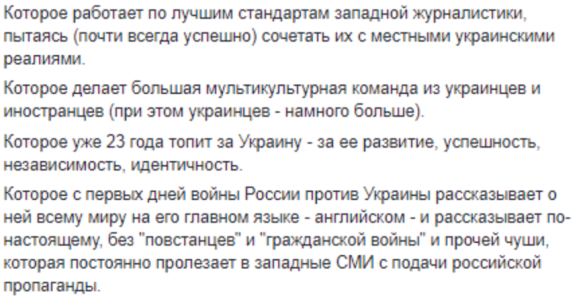
Which works according to the best standards of Western journalism, and attempts to (almost always with success) combine them with local Ukrainian realities.

Which is made made by a multicultural company made up of Ukrainians and foreigners (Ukrainians make up a majority)

Which supported Ukraine over 23 years, supported her development, success, independence, and identity.

Which from the first day of Russia’s war against Ukraine is telling the World about [Ukraine], in [World’s] main language -English- and is telling the truth, without “rebels” and “civil war” and other nonsense, which constantly makes its way into Western media through Russian propaganda.

***

If Russia really waged war in Ukraine, it would be “lights out” for Ukraine.

Kyiv Post risks being shut down over a Language Law

Strana.ua reports…

New language law, approved in first hearing on 4 October, threatens the existence of the only full-fledged English language medium in Ukraine, said Olga Rudenko, depute editor of the Kyiv Post on her Facebook page.

In case the new law is enacted, the only way one could produce media in Ukraine not in the state language, would be to produce a parallel version in Ukrainian.

“In the case of Kyiv Post this is impossible. We do not have the resources to produce another newspaper -to pay for the print (which is not cheap), hire new staff, which would (very quickly) transcribe the articles into Ukrainian. In the end, it is simply impossible from a logistical point of view. Yesterday, we handed over a new volume [for print] around midnight because many of the articles were ready rather late. It is simply impossible to cram into this process the publishing of another parallel newspaper in Ukrainian.”, wrote Rudenko.

Same rules do not allow the functioning of the Kyiv Post website. “I understand that the law aims to strengthen the position of the Ukrainian language over Russian. But the law does not specify or divide -there is only state (that is Ukrainian) language and all the others. That is, English is equal with Russian.” -the editor of Kyiv Post remarks.

She thinks, Russian language media will suffer less than Kyiv Post. [translator’s note: Rudenko said Russian language media can turn on an electronic translator, and it works fine. They can keep a “google translated” version of their site just for the looks.] Furthermore, the deputy editor thinks there is no point in having an Ukrainian version because the Kyiv Post fills a niche by performing the function of informing the English speaking readership about events in Ukraine.

“We will now fight to include corrections within the law at its second hearing, which would add an exception from the law for English or the languages of the European Union.” -said Olga Rudenko.

***

I am amazed to see the Russian speaking Rudenko [she wrote her moaning rant on Facebook in Russian] not attempting to fight for standards of the European Union to be implemented in the language sphere in Ukraine. Half of Ukraine but perhaps most of Ukraine, speaks and thinks in Russian, including Rudenko. Yet, Russian speakers like her for some reason support the replacement of their own language, an international language, with a regional rural vernacular that has a questionable significance even within Ukraine.

If all the languages of Ukraine enjoyed the same rights, Rudenko wouldn’t have this problem…

Big Ukrainian Kaboom

Every couple of months, Ukraine experiences fireworks…

Ammunition in military arsenals keeps blowing up. Most recently on 9 October, in Ichnya, in the Chernigov region:

But according to Gordon, these types of explosions seem to happen with regularity. Below is an explosion in Artemovsk, in Donetsk region, now called Bakhmut after decommunisation. Apparently, the head of the arsenal and a major were cutting metal for sale.

Series of explosions happened in Novobogdanovka, in Zaparozh’e region, from 2004 until 2007. The reason was soldiers smoking near ammunition.

Then in 2008, another blast happened in Lozovaya, in the Kharkov region. The commander at the arsenal failed to clear out a dump, which caught fire.

In 2015, another storage of ammunition blew up in Svatovo, in the Lugansk region. It was blamed on terrorism.

Last year fire and explosion happened in Balakleya, in the Kharkov region, and it was also blamed on terrorism and sabotage.

Here are some more videos from the site:

Also last year, explosion happened in Kalinovka, in the Vinnitsya region. And it was blamed on guess what? Sabotage!

It would seem the Maidan regime cannot think of anything else than sabotage to blame these blasts on. But no, this year’s explosion was blamed on “negligent attitude of the assigned serviceman that has led to severe consequences”. I heard they were stealing ammunition and blew up the arsenal to cover tracks.

But do not worry, NATO standards are here to save the day:

Screen Shot 2018-10-12 at 08.38.19.png
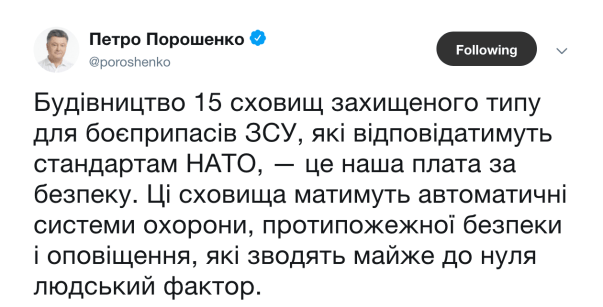
The construction of 15 reinforced storages of ammunition of the Ukrainian Armed Forces, which follow NATO standard, that is the price we pay for safety. These storages should have automatic defence systems, and fire safety and warning, which should reduce human factor to zero.

How I would write Ukrainian History?

This is a thought that occurred to me a long time ago…

Ukraine lacks a medieval statehood, unlike say the Czechs. For a Czech historian, the task of writing a history of his nation is much easier because the Czechs had a state of their own since the Early Middle Ages, even the Habsburgs were Kings of Bohemia. Hence, a Czech historian can create a linear history from the Middle Ages to the present day.

In contrast, Ukrainians attempt to create a linear history out of poorly linked episodes of statehood, from the Galician Kingdom to the Cossack Hetmanate. Sometimes they go as far back as the Scythians. And like this they end up with nine volumes about a fictitious hybrid entity called Ukraine-Rus. Things could be made easier if we consider the following statement:

The Ukrainian nation is a product of a creole culture that resulted from centuries of Polish rule over the south-western portion of Rus. The idea of Ukrainian nationhood was first conceived of by Ukrainian nationalists towards the latter part of the nineteenth century. Ukrainian national movement was able to achieve statehood. 

I would write the history in such a way to describe the development of this creole culture, which eventually crystallised into a national movement. I would start with the break up of Rus, and its eventual absorption by Lithuania and Poland. The primordial beginnings of the Ukrainians are here. One could talk about the Kings of Galicia-Volhynia and their relationship with the West, the Union of Lublin, which brought the Western and Central Ukraine into Poland, the difficult relationship of the Cossacks to the Rzeczpospolita, and the subsequent difficult relationship to the Russian Empire, and the resultant Ukrainian movement.

This conception gives Ukraine a common history with the Western World, and yet does not deny its link to Rus. It also does not lay any exclusive claims to the history of Rus because it is a purified story of the Ukrainian experience. Obviously, it could be attacked on the basis that my theory of creolisation needs justification. But that would not be that hard:

HwyPg.jpg

Source

The Simmering War Will Never End

Why Kiev has no interest in ending the current status quo…

This will be a short post which will explain the reasons why Kiev in some way benefits from the current low burning conflict in the Donbass.

  1. The simmering conflict in Donbass does not create much war weariness in the generally apathetic Ukrainian populace. I believe that restarting it would be too much of a gambit for Kiev. Peremoha (Ukrainian for “victory”) is not assured, and nobody needs to wake the mother bear from her slumber.
  2. Back in January, the Ukrainian parliament, overwhelmingly approved a law defining Donbass republics as a territory occupied by Russia, and called Russian Federation an “aggressor”. This is all very nice but the Ukrainian government failed to declare war on Russia. Also, the war is called “hybrid war”. Whatever that means, it is not a normal war. I doubt even Ukrainian officials understand what they are saying.
  3. Therefore this war, which is not war, is to never end. Because it would mean confrontation with the aggressor. But meanwhile, this lack of clarity serves the Kiev regime in more ways than one.
  4. It keeps one of the hotbeds of Antimaidan, together with Crimea, outside the Ukrainian political game, ensuring a long term electoral victory for pro-Maidan forces.
  5. Even if we consider that upon Ukraine’s seizure of the republics by force, the territory will be ethnically cleansed, Ukraine would be left with a destroyed territory that would require investments to rebuild. Like this, Donbass is a Russia’s problem and a Russia’s headache. Besides, Russia’s poor handling of the republics only plays into the hands of Ukrainian propaganda.
  6. Speaking of propaganda, in a state of a hybrid war that is not actually a war, anyone critical of the government can be labelled as agent of Putin, and silenced. Not happy with the economic situation? Shut up you Kremlin scum!
  7. War, that is not war, also allows the government to blame any hardship on Putin, and blame any tragedy, like the recent explosion of a military arsenal in Chernigov region on Putin.
  8.  The simmering war allows some people to make money. Although, too many guns unaccounted for might cause a security dilemma, the powers that be in Ukraine are hardly bothered by this.

That’s basically it, that’s why the war, which is not really a war, will never end…

Why Taking Ukraine in 2014 Would Have Been a Bad Idea?

There are some people that accuse Putin of abandoning a unique chance in 2014 to stop the “Banderovites” that took over Kiev…

I heard similar stuff from Russian nationalists recently at Sputnik & Pogrom podcast with Aleksandr Zhuchkovsky, a militia man in Donbass, and then I saw this Sovok post below. Unlike Russian nationalists, some out there even believe that Russia should have helped Yanukovych back to Bankova.

Screen Shot 2018-10-08 at 21.54.48.png
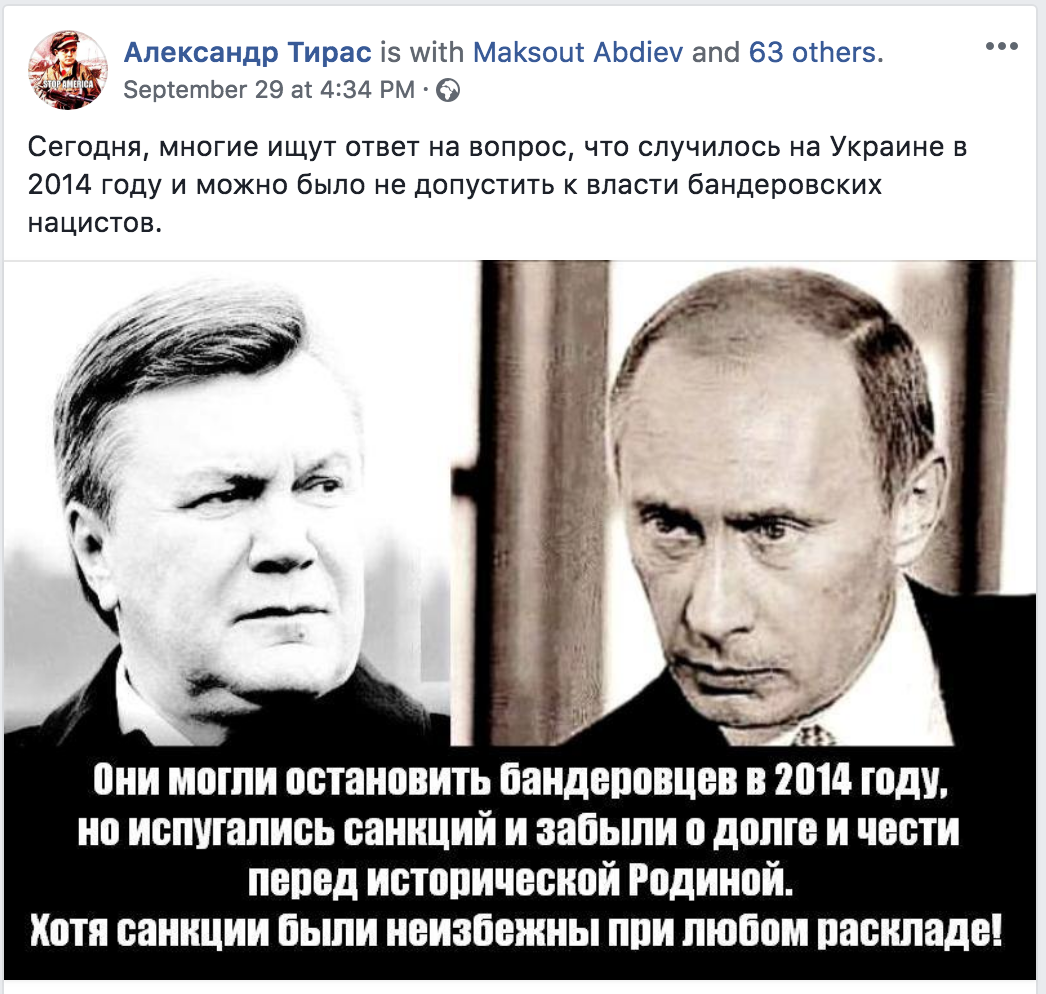
“Today, many seek an answer to what happened in Ukraine in 2014, and was it possible to stop the banderovite nazis from coming to power?” AND ON THE MEME: “They could have stopped the banderovites in 2014, they were spooked by sanctions and forgot about honour before the historic motherland (USSR?). Even though, sanctions were inevitable, no matter what!”

Criticism of Putin’s handling of the Ukrainian crisis finds a home both on the right and on the left of Russia’s political spectrum, among opponents of Putin. One can definitely find flaws in the handling of the Donbass crisis. Russia’s current position is that the republics are “self-declared”, this is what the Russian media refer to them as, that they are part of Ukraine, and that they should be reintegrated into Ukraine in some form of a federative arrangement. The kremlins’ view recognition of the Donbass republics as a step in the extreme, perhaps after Ukraine attempts to take the republics over by force.

On the other side in Kiev, Donbass republics are viewed as a part of Ukraine, forcibly torn away by Russian aggression. According to Ukrainian constitution, Ukraine is a unitary state, and without a change to the constitution, federalism is impossible. The Ukrainian parliament eagerly changed the constitution recently to include aims to join NATO and the EU. However, I do not see the same enthusiasm about federalism. This disparity in views between Kiev and Moscow, the resultant lack of recognition for the Donbass republics, high levels of criminality, and poor handling of the republics by Russian curators as Anatoly Karlin notes, don’t add to Russia’s good image.

But was reinstating Yanukovych, or creating Novorossiya ever a good idea? I have recently read a compelling case against this that mentions reasons other than just the threat of sanctions. Sergey Belov on Alternativa imagines in five points what would happen if the Kremlin did not limit itself to Crimea:

First of his arguments is that Russia would be forced to support the odious persona of Viktor Yanukovych as the legitimate president. He says, other than the Regionnaires there aren’t any other pro-Russian politicians in Ukraine. The latter I would disagree with but given that Regionnaires have now all become United Russia members in Crimea, this is probably what would have happened. The kremlins seem very comfortable with former Regionnaires but even they must realise that the relationship with them was counterproductive.

Belov’s second argument is that Russia would have to enter some serious military conflict. If not with the Ukrainian army, then with the Ukrainian nationalist battalions. He said the Ukrainian nationalists would likely resort to guerrilla tactics of terrorism and sabotage.  I am one of those that believes Russia intervened in some capacity to help the Donbass republics, which official Russia denies. But given kremlins’ efforts to freeze the conflict, Donbass conflict barely registers in Russian public opinion. Russian public would, according to Belov, not approve of casualties. The ideology of the post-soviet public is that of comfort and abundance, in the words of youtuber Denis Seleznev, and too many casualties would probably not sit well with the Russian public.

Thirdly, maintenance of the occupied territory would put a strain on the Russian budget, and the money would likely be stolen by the Regionnaires. Furthermore, it would be difficult to satisfy Ukrainians that had just been promised prosperity in the EU.

Fourth argument concerns gas exports. Under occupation of Ukraine, Gazprom would be in a precarious situation in which transit through Ukraine would remain in place. Pipelines could be easy targets for nationalist resistance. One can only remember how Ukrainian nationalists blew up electric lines going to Crimea. Northstream2 and the Turkstream are still not finished yet. Gas exports are a major source of revenue for the Russian budget, and something “Putin’s Western partners” will be reluctant to put sanctions on.

And finally the fifth argument is that any occupation regime in Ukraine is always forced to buy loyalty of the “titular nation”, and would have to support local language and culture. Basically, Russia would need to engage in feeding Ukrainian separatism much like the Soviet Union did to her own detriment. While some Russian nationalists may entertain the notion of invading Ukraine with the aim of instituting a Russification programme. The reality is that not even the Russian Empire, which denied the validity of Ukrainism altogether, was able to do anything about it.

As we can see, sanctions may have been inevitable, but that clearly was not a reason to invade Ukraine and reinstate Yanukovych. Novorossiya from Transnistria to Donbass was likely not feasible either. I doubt Russia is economically strong enough to absorb 20 million people. We can only wonder why the liberation of Donbass was not completed but I think the kremlins were more interested in freezing the conflict than having to take care of the entire Donbass. Always remember the words of Yarowrath, the ideology of the Russian elite is “less people more oxygen”, so tough luck.

Gas Anaconda

Translated from Peremogi. Anaconda refers to the Anaconda plan. The Anaconda plan entered Ukrainian discourse in 2014 when Ukrainian forces tried to cut Donbass republics from the Russian border. You may be asking, what do these news have to do with Ukraine? Right,nothing!

1. In two month, Gazprom will finish building the marine section of the Turkstream.

In two months, Gazprom will finish building the marine section of the Turkstream, announced CEO of Gazprom Alexei Miller on an international forum.

“The construction of the Turkstream pipeline is ongoing, very soon the marine section will be completed.”

Late August report said the Turkstream is 80% completed.

Source1

2. Russia’s earnings from oil and gas have risen by more than a third.

In eight month of 2018, Russian earnings from the export of oil have risen by 35.5% in comparison with the same period in 2017, totalling  $8.2 billion, according to data of the Federal Customs Service.

Source2

3. Gazprom continues to increase gas exports into Europe.

In the period between 1 January and 30 September, Gazprom increased exports to non-FSU countries by 5.8% (by 8.2 billion cubic metres) in comparison to the same period last year. Press release of the holding says 149.2 billion cubic meters were delivered to buyers in Europe.

Export to Germany grew by 12.3% (4.7 billion cubic metres), to Austria 33% (2 billion cubic metres), to Netherlands 40.1% (1.3 billon cubic metres), to Poland 11.7% (0.9 billion cubic metres), to France 9.4 (0.8 billion cubic metres), to Hungary 11.5% (0.6 billion cubic metres), to the Czech Republic 12.3%, to Denmark 8.5%.

Likewise, September was marked by an increase in exports to East European countries: to Poland by 59.1%, to Hungary by 39.3%, to the Czech Republic by 23.4%. Total export of natural gas increased by 8.1% in comparison with the same month of 2017, to 15.9 billion cubic metres.

Source3

4. German company Wintershall is ready to provide additional financing to the Nordstream2 pipeline.

German oil and gas holding Wintershall announced its readiness to provide additional funding towards the successful completion of the Nordstream2 project along an alternative route should Danish authorities decide not to provide a permit to lay the pipes in their maritime one, announced Wintershall’s board member, Thilo Wieland.

Source4

5. Yamal LNG shipped its fifth million tons of LNG in September.

Since the plant’s launch in December 2017, Yamal LNG exported 5 million tons of liquified natural gas (LNG), NOVATEK announced on 25 September.

Fifth million ton was shipped from the LNG plant on the icebreaker LNG carrier Christophe de Margerie in sixty-eighth shipment from the moment of the first shipment made in December 2017.

[section omitted, too technical, if you are able to give a translation, please send it to insomniacresurrected@gmail.com]

On 19 July 2018, first load of LNG was delivered to China.

On 24 September 2018, first load of LNG was delivered to Brazil.

Source5

6. The dates of the launch of the third line of Yamal LNG became known.

The head of NOVATEK Leonid Mikhelson, at a session of GECF in Sabetta, in the framework of Russia’s gas week, disclosed that the launch of a third line of Yamal LNG will take place in December 2018.

“In December 2017, the first line was launched, in August we launched the second line, that is six months earlier, we have practically doubled the LNG production in Russian Federation. The third line we are planning to launch in December, that is a year earlier than planned.”

Source6

***

In other news, former Ukrainian president Leonid Kuchma recently had an epiphany”

“…Germany perfectly understands that when the Nordstream2 will be completed, our pipeline will not be, it will be empty. Because in 2019, they are also opening Turkstream… We are making 2 billions a year currently but in the future it will be zero…

Insomniac Resurrected

Hello Everyone!

Some of you may remember my old blog “Austere Insomniac” that I started at the end of my undergraduate studies. Sadly I had to delete that website somewhere in 2015, I was going through a difficult period. For short, I had a serious accident that left me crippled, and my parents have divorced, which has led to a complete breakdown of my family.

Almost simultaneously, the object of my passionate interest, that is Ukraine, was going through a similar process of disintegration and alienation from neighbours and relatives. But much like my life, the situation there has stabilised, and due to this strange correlation between my fate and Ukraine’s, I can actually only hope the country does not disintegrate any further.

My interest, in more specifically the identity issues in Ukraine has not left me. I discovered I post Ukraine related content on Facebook and decided to create a separate home for it…

Welcome, and enjoy!