
Why do peddlers of Holodomor resort to lying? I had to drop some truth bombs…


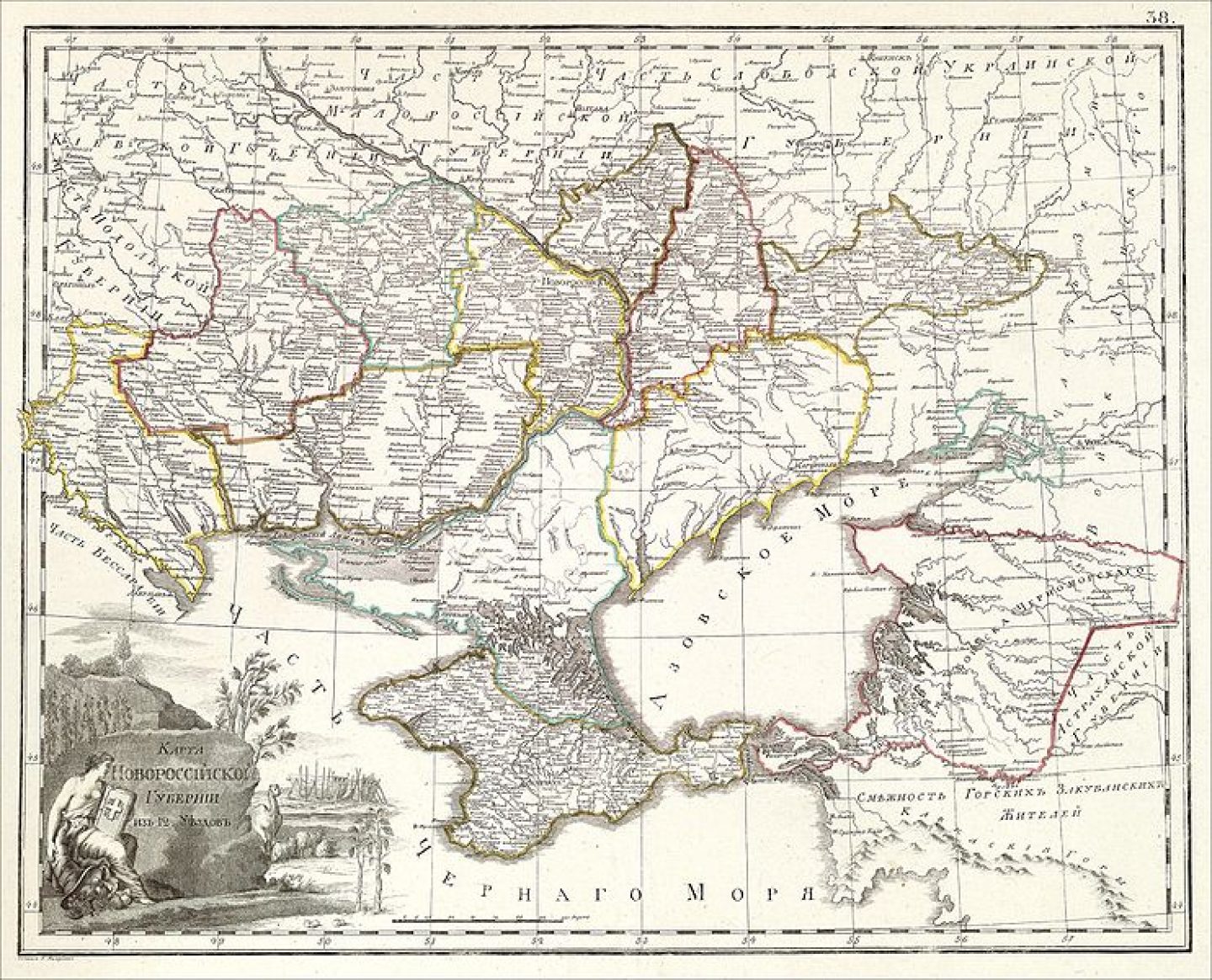
Why do peddlers of Holodomor resort to lying? I had to drop some truth bombs…
Anita Błaszczak in Rzeczpospolita writes…
This is the last bell to struggle over for workers from Ukraine, who are already being recruited by the Germans. They are also being picked off by the Czechs and Slovaks, who are luring them with higher salary and a two year contract.
Already now, the Czechs are taking increasingly more Ukrainian workers from us, and soon the time will come for Germany, where a large part of professionals can leave, warns Marian Przeździecki, director of the Ukrainian branch of the “Work Service” employment agency. He says, despite huge demand from domestic companies, it is increasingly difficult to make work in Poland attractive for Ukrainians.
First, staff shortages are growing in Ukraine, especially in Western regions. Second, this year competition for Ukrainian citizens has significantly increased from the Czechs and Slovaks, who have liberalised entry procedures. This was confirmed by other agencies that specialise in recruiting Ukrainians. Krzysztof Inglot, head of Personnel Service, which already has three companies in Ukraine, admits that this year Czech and Slovakian companies are recruiting on a much larger scale than before.

CZECH OFFENSIVE
Michał Wierzchowski, is director of the employment agency EWL, which this year wants to bring over 15 thousand employees from Ukraine. Recently, the company also opened an office in Prague, Czech Republic. It wants to take advantage of the boom of Ukrainian employees there. [He says:]
“Despite the announcement of liberalisation of procedures for Ukrainians, nothing is happening. We are standing still, while other countries are beginning to open to them.”
In the Czech Republic where salaries are one third higher than in Poland (and in automotive industry even 50%), Ukrainians can now easily obtain a visa for 90 days, and then an employer can employ them on a 24-month work card, which is part of a government programme “Režim Ukrajina” (see here at Czech Ministry of Foreign Affairs). The card pool has been doubled to 20 thousand this year. Next year it should be doubled as well.
Although, Ukrainians have to wait up to a year for such a long term visa (just like it is with work permits in Poland). However, a system of “informal accelerations” can shorten the procedure to 2-3 months. In addition, after one year you can bring your family to the Czech Republic.
Czech Minister of Labor and Social Policy Jaroslava Němcová has visited Ukraine twice this year and during the last September visit announced the introduction of a fast administrative path for employees in selected occupations, including babysitters. Already now, Ukrainians can more easily get the right to a two-year stay in Slovakia, where wages are around 20 percent. higher than in Poland.
Competition from Germany can soon become a greater problem. Since January 2019, the labor market for non-EU labor migrants, including Ukraine, has been to open more widely. From January 2019, the labor market for non-EU labor migrants, including from Ukraine will be been open more widely.
NEEDED STABILISATION
Marian Przeździecki claims that Poland ceased to be the leader of openness to employees from Ukraine. He explains:
“We fell to the last place in the region. In addition, we lag behind competition in terms of pay, and the housing conditions of employees are often worse.”
According to him, the main problem is in a limited, six months working time in Poland according to the simplified visa procedure for the so called permit. Declarations by the Ministry of the Family Labor and Social Policy that they will longer it to a year in autumn have not been implemented.
Marian Przeździecki says:
“If we do not do it, if we do not introduce facilitations that encourage permanent work and the settlement of workers from Ukraine,, we will soon lose them.”
He points out that the current system of statements supports the inflow of unskilled seasonal workers from the East, and discourages the arrival of specialists in Poland, who care for stable employment and settlement with their families.
Krzysztof Inglot says:
“We should extend the work to a license of up to 18 months and give Ukrainians incentives to work legally and bring families.”
As the head of Work Service in Ukraine says, Ukrainians or Belarusians seeking a long term residence in Poland do not have any preferences…
“They are treated the same as visitors from Bangladesh or Nepal, even though they (the Ukrainians) are culturally close to us and they adapt fast. If they could live in Poland for longer with their families, they would be more motivated to increase their qualifications. They would not change work so often from 1 or 2 zlotys of hourly rate increase, which has become a nightmare for companies, particularly in construction.”
OPINION
JACEK PIECHOTA, president of the Polish-Ukrainian Chamber of Commerce
Our advantage in competition for employees from Ukraine is geographical and cultural proximity, and the fact that many [Ukrainians] are familiar with living conditions in Poland.Despite this, competition from countries where wages are higher is a real threat. Despite this, competition from countries where wages are higher is a real threat. In addition, our country’s migration policy is not very clear, the waiting time for residence and work permits is not being shortened, and some politicians combine labor migration with the migration threat. An open government declaration is needed that Ukrainians are welcome in Poland. It is also worth showing positive examples of their employment and integration, which we do in the social campaign “Partnership and employment”(„Partnerstwo i zatrudnienie”).
WORK AND SUPPORT THE ECONOMY
Transfers of money from Ukrainians working abroad has risen to $11.5 billion and is expected to increase in 2018 – estimates National Bank of Ukraine. Last year, Ukrainian migrants sent over $9.3 billion back to the country (about 9 percent of the GDP). As is estimated by the Ministry of Social Affairs of Ukraine, 3.2 million citizens of this country work continuously abroad, and another 9 million seasonally. A large part of both groups goes to Poland, where the number of employees from Ukraine is estimated at 1.8-2 million. As the Association of Entrepreneurs and Employers warns, the outflow from the Polish labor market of even some of them (in a moderate variant – 500,000) may lower our GDP by 1.6%, which was 1/3 of its growth in the previous year. For several years, employers’ organizations and economists have appealed for a coherent Polish migration policy. It was not ready in summer and in autumn it was returned for inter-ministerial consultations. The ministry of investment and development explains:
“The migration policy touches upon many topics, and their reconciliation takes time.”
***
Earlier this website already wrote about the volumes of Ukrainian labour migration to the EU, about staff shortages in Western Ukraine, and about Ukraine rapidly losing her human capital.
Ekonomichna Pravda reports…
Russia has prohibited transport of Ukrainian goods and Ukraine tried to establish a road around [Russia]. However, the “Silk Road” project did not work. What happened?
After the introduction of transit embargo on Ukrainian goods by Russia in early 2016, Ukraine has joined the international project “Silk Road” -a route circumventing Russia.
Not long after that, the first, experimental train, which included both a railway and ship across the Black and the Caspian sea, was launched along the route out of the port Chernomorsk, through Georgia, Azerbaijan, Kazakhstan, and into China.
Highest rank officials have taken part in the launch ceremony: the Minister of Infrastructure, Andriy Pyvovarskyi, the Minister of Economic Development, Ayvaras Abramovichus, Deputy Prime Minister, Hennadiy Zubko, and also the head of Odessa Regional State Administration, Mikheil Saakashvili.
The first train attracted attention in Europe and Asia. A special map was published on the website of Ministry of Infrastructure, with the help of which one could track online the movement of the train.
It was mentioned that the train will start working in a business regime within several weeks. However, from the beginning something went not according to plan. Subsequently, all the people involved in the launch have mentioned this project less and less, and then the project completely disappeared from the information field of Ukraine. What happened?
Test train
On 15 January 2016, Ukraine launched an experimental freight train to China, along “the Great Silk road”, circumventing Russia by going through Georgia, Azerbaijan and Kazakhstan.
After the launch, then Minister of Infrastructure, Andriy Pyvovarskiy, said the train could start working fully starting March 2016.
The train was composed of ten cars and twenty 40-foot containers. The cars were partially empty, and partially loaded with metal products* to be offloaded in Georgia. The empty cars were to be loaded with products in China.
It was expected that the duration of the route to Dostyk, on the border of China and Kazakhstan, would be 11-12 days. Back then, the Ministry of Infrastructure informed us that the test train was launched to workout the route, and for operators of the train to establish mutual working relationships in the participating countries.
The demonstrative train went through the Black Sea, and through main stations, the port of Batumi, Alyat, Aktau-port, Beyneu, Zhezkazgan, Balkash-1. After 15.5 days the train arrived in its final destination, to the Dostyk station, which is on the border of PRC. After that, the cargoes should have gone to the large industrial cities of China. 
After that, problems began. The train has been stuck at the Chinese border, and it could not return for a long time over the absence of clients. Only on 7 April the train was dispatched empty out of the Dostyk station, and it arrived in Chernomorsk on 19 April.
The Ukrainian Railways have said the regularity of the train would depend on market demand. The company said in April: “At this time, the potential traffic flow is being studied, which can be reoriented into a transport train. We are looking at making this a regular service.”
A train that couldn’t
Questions about the way have already appeared during the preparation phase of the project. The experts talked about a significantly longer delivery time in comparison with the habitual route through Russia, and about the regularity of trains, which prevented businesses to schedule loads.
Doubts have also risen around the two maritime stages of the route: the train was exported on ferries across two seas. That is four entries into a port, ride on a specially equipped ferry, and a high probability of adverse weather.
According to an expert in river and maritime transport of the Ukrainian Logistic Association, Oleksandr Lysenko, first they should have studied the demand for this route.
Was this done?
The Ministry of Infrastructure said domestic producers of carton, stone, ceramic tiles, rubber products, metal constructions, furniture, food and agricultural products are interested.
Judging by the fact that the train did not become regular, there did appear any demand.
After two and a half years, EP (Ekonomichna Pravda) asked Ukrainian Railways what is going on with the project since nobody announced its closure.
It seems nobody is engaged in it. We received the same answer from the company which was publicised already in April 2016. [Exactly] word for word:
“At this time, the potential traffic flow is being studied, which can be reoriented into a transport train. We are looking at making this a regular service.”
During this time, the company only determined the single comprehensive cost of transport on the route: Slawkow (Poland) – Altynkol’ (Chinese-Kazakh border) for a 40 feet container. It is $4281, and the journey takes 15 days. We did not receive any information about a commencement of regular work of the project from the company.
For the future
Experts the EP has asked say the project has failed because it could not compete with other variants of transporting cargo from China to Europe.
Oleksandr Kava says:
“Other routes had been more attractive than the so called Transcaspian route, since it has many intermodal moments: [that is] reloading from the railroad to one ferry in the beginning, then another ferry. The number of container trains on the Eurasian route through Kazakhstan, Russia and Belarus is increasing. While the Transcaspian corridor has stagnated.”
Ivan Ous, an expert of the Institute of Strategic Studies also acknowledges the economic bankruptcy of the plan:
“The project had political pluses. It was a period when Russia began to restrict our export. Back then it was important. However, it is more expensive, and the business did not immediately agree with it.”
Former Deputy Minister of Infrastructure, Volodymyr Shul’meyster says:
“The first question is cost, the second is regularity. The Businessmen cannot make orders if they are unsure whether the train will run.”
That is a one important aspect, which has to do with marketing. According to Shul’meyster:
“Problem was in how to correctly “sell” this route. The Ukrainian Railways have a weak marketing policy that’s why they cannot sell normally, even though there is a demand for such a train. Finding a cargo on both sides is a major problem. The more full [the train] will be, the cheaper it will be.”
Does this project have a future? Opinions on this differ. Kava said:
“It doesn’t have any future. Even after the route got cheaper, the dispatchers prefer the Russian option because in that case the cargo moves on the railway the whole time. They increased the speed of traffic and the Transcaspian route with two ferry lines lost in the competition.”
Ous says:
“I would not abandon this idea. It is an expensive option but one that allows not trading through Russia. Moscow has created a significant problem for us, we have a choice, either expensive or nothing. I think we will use this option.”
Ukrinform reports…
This was said on a press conference, by the president of the National Democratic Institute (NDI, USA). Derek Mitchell, while analysing the pre-election environment in Ukraine.
“Social divisions, we have to be careful about those… The Russian will take advantage of any element of social division. They are opportunists… they will find those divisions and they will exploit them. So one way to prevent it, or to inoculate one self against it, is to allow for the natural political debate, political contest to go on. But ensure that political contest does not bleed into use of techniques or messages that exacerbate social division. We make that point in the statement. Once you do that, once you play on some of the foundational issues of the country, then the Russians can much more easily play indirectly but also through digital platforms like Facebook or others. So that’s why we call for Facebook explicitly to leave the office in Moscow and come to… they can maybe have it in Moscow… but have also an office in Kiev. With Ukrainian speakers. The folks, who are focused 24/7, in a war room environment, they had this for our election, recent mid-term election. For others, if they test it, kind of 24/7 war room to ensure their platform is not misused for misinformation, for hate, to exacerbate social divisions that create instability, to really undermine a society… in a country. So, I think there are responsibilities by those on the outside not to create problems, there is certainly more need for more digital literacy in internally, so people know what they are seeing and identify when they are being exploited potentially by Russian disinformation. You can for instance, we talked about advertisements on TV, which should be marked, who are the funders of that. So there is… more transparency the better. The more that society is working together during the electoral period and there is confidence in the process. Then the Russians have less ability to exploit those divisions for their own ends. So there are things that can be done, even if they try through other methods to hurt the stability, security and unity of the country.”
That’s enough…
Number of western outlets (see Daily Mail, and this major Czech newspaper) reprinted an Associated Press story about a camp organised by Svoboda party that teaches kids to kill Russians, and about the toxicity of West European leftism…
It begs a question, why suddenly does the American press see fashiks in Ukraine? I thought they were rather cool with that in Washington.
I quote from the AP story:
“We never aim guns at people,” instructor Yuri “Chornota” Cherkashin tells them. “But we don’t count separatists, little green men, occupiers from Moscow, as people. So we can and should aim at them.”
It is important, he says, to inculcate the nation’s youth with nationalist thought, so they can battle Vladimir Putin’s Russia as well as “challenges that could completely destroy” European civilization.
Among those challenges: LGBT rights, which lecturers denounce as a sign of Western decadence.
…
“You need to be aware of all that,” said instructor Ruslan Andreiko. “All those gender things, all those perversions of modern Bolsheviks who have come to power in Europe and now try to make all those LGBT things like gay pride parades part of the education system.”
…
During a break in training, a teenager played a nationalist march on his guitar. It was decorated with a sticker showing white bombs hitting a mosque, under the motto, “White Europe is Our Goal.”

I was recently watching a recent podcast of Egor Prosvirnin of Sputnik & Pogrom fame…
In it, Prosvirnin regrets (much like I do) the recent elections in Donbass, which could have been used to legitimise local governments, were instead planned in a classically Putinist way to have a predictable outcome, which would result in the victory of a candidate easily manipulable by Moscow’s curators.
Nevertheless, Prosvirnin brings attention to the words of Alexey Chesnakov, the director of Centre for Political Conjuncture, who according to Prosvirnin is a mouthpiece used for communication with the public of Vladislav Surkov, the person Kremlin made responsible for Donbass. According to Chesnakov:
“…the electoral campaign, and unprecedented voter turnout have shown high support of the citizens to a course chosen by the government of the republics in 2014. It is a definitive victory of pro-Russian electorate, and pro-Russian forces.”
This is an unprecedented acknowledgement of the interests of the Donbass peoples from somebody purportedly a spokesman for the Kremlin. Of course, the system does not imply annexation by Russia but it is a confirmation of the situation in which the two republics are dependent territories of Russia. Does it mean abandonment of the failed effort to impose federalisation upon Ukraine? I can’t say!
Meanwhile recently, on the other side in Kiev, the Foreign Minister of Ukraine Pavlo Klimkin, or whoever writes posts on his Twitter, has once again demonstrated the unwillingness and inability of Kiev to integrate Donbass.
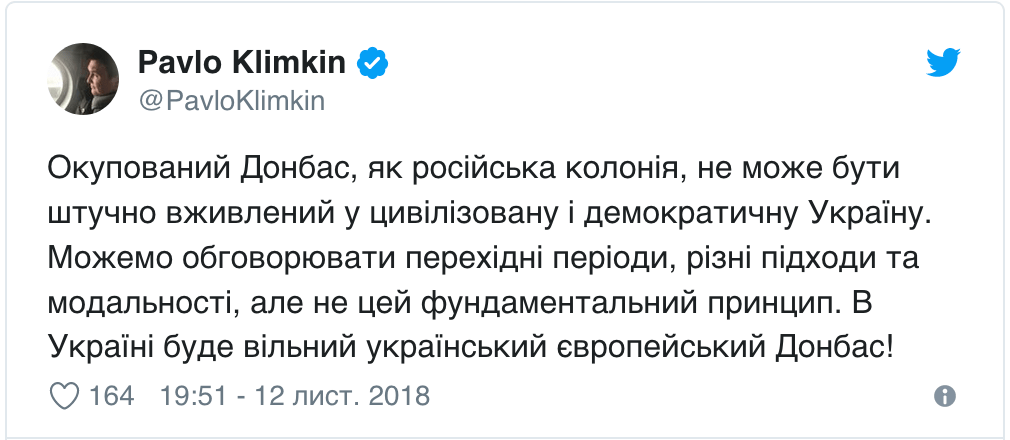
The idea that Donbass, with its current consciousness is somehow unfitting for Ukraine is not new. Klimkin’s above Tweet is just a sanitised repeat of the street version. Klimkin however acknowledges Donbass’ dependence upon Russia in the wake of Donbass elections, much in tune with what Chesnakov said.
And finally, check out a new video that I posted on my youtube channel, it allegedly comes from Lugansk on election day. It suggests a lot…
Deutsche Welle Ukrainian service reports…
Even though Ukrainian firms are trying to keep their workers, they are filling the ranks of labour migrants. And higher salaries are not the only impulse that drives them.
Not even favourable location, where there aren’t any other large firms, not even increase in salary, not even bonuses for workers saved a firm with German investment ,the Private limited company “Elektrokontakt Ukrayina”, in the Lvov region, from the lack of workers. The factory of 2.5 thousand workers makes electrical equipment for German cars. The number of orders the firm receives is constantly growing but the number of workers, especially with the beginning of spring, is on the contrary dropping.
The director of HR of the company Roman Kuybida explains:
“Abroad, seasonal works begin and workers often go there to make money. After the season is over they come back, and the majority wants to work for our firm. Their main argument is usually salary, which is higher over there than in Ukraine.”
To keep workers, the factory constantly improves upon the conditions of work, in particular they increase the salary. The median salary is now 9.5 thousand HRN for the manufacturing personnel. Apart from that, the workers are being offered opportunity for career growth, official employment, free healthcare, transport to work, cheap meals, and so on.
Kuybida continues:
“The shift is eight hours in our factory, safe conditions for work. In Poland, to receive a decent salary, for instance twice that as in Ukraine, one ought to work 12 hours per day.”
Why Ukrainians are leaving for abroad
Millions of Ukrainians are working abroad. We do not have exact statistics as to the number of Ukrainians who became labour migrants. The counting is complicated by the fact that many people work illegally, or on seasonal basis. But this trend continues even now. In September, the Minister of Foreign Affairs, Pavlo Klimkin estimated the volume of labour migration out of Ukraine could be million persons per year.
The fact of significant outflow of workers from Ukrainian firms was also mentioned at the Federation of Ukrainian employers. The director of the federation, Ruslan Illichov says:
“The staff shortage crisis caused by the outflow of workers abroad is the result of a badly thought out policy which was conducted in the country for years. Ukraine was built up as a resource exporting country. In such countries where industries with low added value are developed, there cannot be high salaries.”
According to him, Ukrainian employers no longer have the reserves to further increase salaries. The reason he says is the increase of financial burden on business, in particular the growth of tariffs, by 30% the tariff on gas in September-October.
Ruslan Illichov asks rhetorically:
“We are now calculating a yearly plan of production. We are including the cost of wages, energy, and other expenses. And suddenly the state increases the tariff by 30%. What should as entrepreneur do? How can I plan to increase the salary under these conditions?”
The experience of the Lvov region
In Lvov region they hoped that the increase in wages by employers would be stimulated by the arrival of new investors.
The head of Lvov Region State Administration, Oleh Synyotka said:
“Competition between firms would automatically lead to increases in salary.”
In 2017, the Lvov region even took sixth place in Ukraine as to the amount of investments received. But а jump in salaries hasn’t been felt. The median salary in the region is 8415 HRN, slightly lower than median Ukrainian salary.
The government of the Lvov region has recently decided to complicate life to agencies that search employment for Ukrainians abroad. According to the politicians, the activity of these agencies is one of the main reasons behind outflow of workers abroad.
In September, the head of administration suggested at a meeting to restrict advertisement to such businesses but has rejected this idea in an interview with DW.
“We cannot prohibit a company, which does not break the law from advertising. That’s illegal. I am just saying that we shouldn’t support activity which is detrimental to the state. Moreover, if there are violations in this business, the state ought to react to such violations. There cannot be cases that a company which engages in the export of people has no license. That’s why we have directed a submission to Ministry of Social Policy to inspect these companies.”
The head of All Ukrainian Association of International Employment Companies Basil’ Voskoboinyk doubts that such an initiative can influence the flow of labour.
“According to data of a sociological research which we have ordered from the sociological group “Rating”, 59 percent of Ukrainians look for job abroad through relatives, friends or colleagues. It is therefore overstated that taking down work agencies would decrease the flow of migrants abroad.”
Although, he acknowledges that plenty of scammers without a license work on the market. In his opinion, if as the result of inspections only legal recruiting agencies remain, this will be of benefit because people will travel to real employers.
The salary is not the only impulse
However, Ukrainians are leaving not only for higher salaries as we were reminder in the Federation of Employers. According to a study which they ordered last year, 40% of labour migrants polled that apart from salary they have other reasons to leave the country, that is instability in the country, lack of fair social policy, [lack of] security, poorly developed healthcare.
Ruslan Illichov expalins:
“Today there are cases where absolutely competitive salary, comparable to Polish is offered. But the people are still leaving because they do not see a future here. It’s politics, which does not depend upon employers.”
Oleh Synyutka also admits that it is not just the salary which is the reason behind migration of Ukrainians. However he gives also different arguments:
“Very often, the people are fleeing their personal problems, from [their] responsibilities. They find it easier to be far away, to once per month send money to [their] families, and to think that they have done their duty to [their] families this way. Therefore it is necessary to instill family values. And that is a collective task of family, church and society.”
***
Earlier this website published the words of Olga Pishchulina from the Razumkov centre, who said Ukraine is fast losing her human capital.
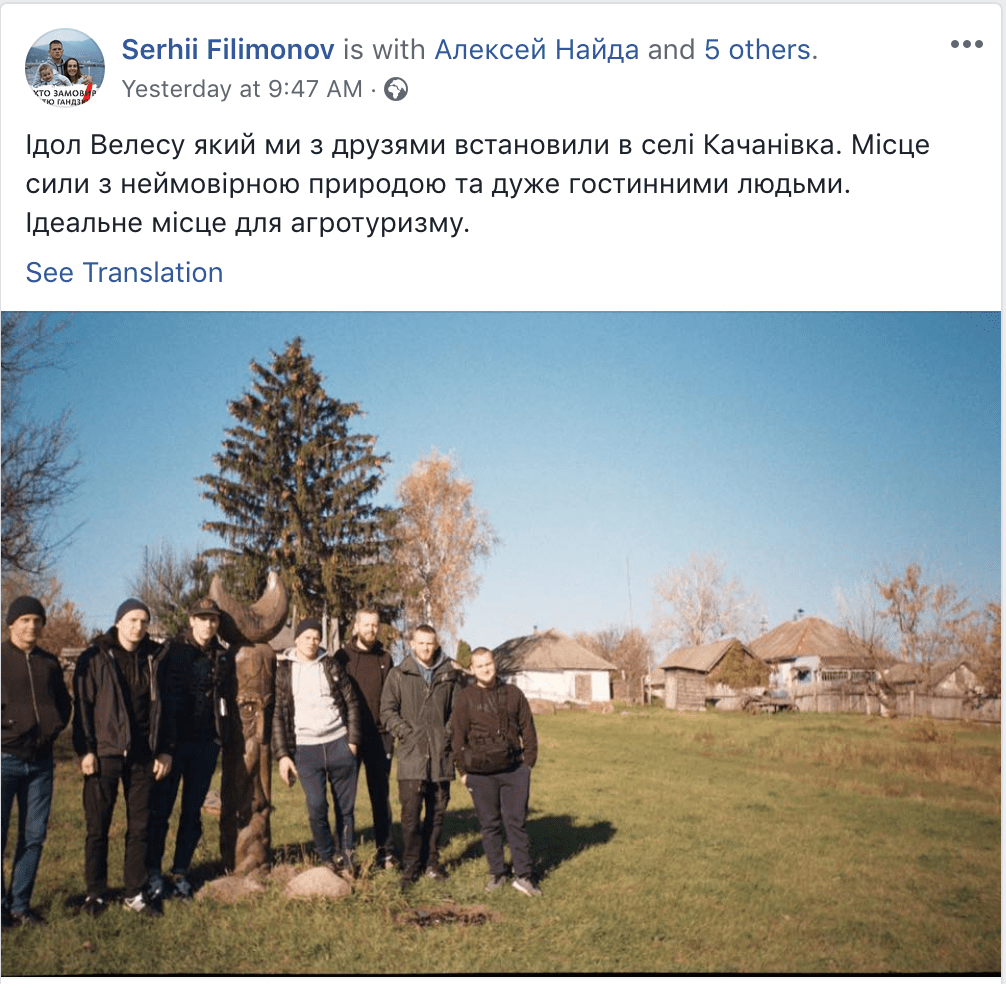
In one of the villages of the Chernigov region Ukrainian Nazis, militants from the punitive “Azov” battalion, established a pagan “place of power” and also installed a wooden idol for the purpose of carrying out ceremonies there. This was reported by the head of the Kiev branch of the radical “National Corpus“ organisation, which was founded on the basis of the neo-Nazi “Azov” regiment, Sergey Filimonov on his Facebook page.
I would like to talk about the stark similarities between the rehabilitation of Stalin and the USSR in Russia and the rehabilitation of Bandera and UPA in Ukraine…
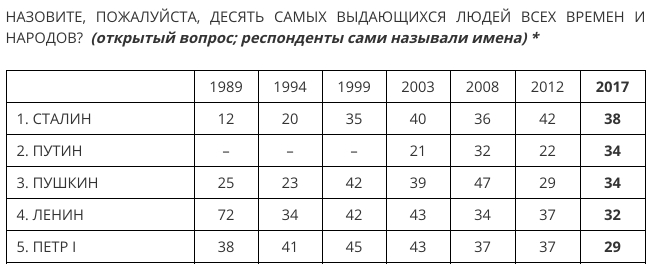
As the two countries came out of the shadow of Communism and gained sovereignty, the cults of Bandera, Shukhevych, the UPA on one hand, and Stalin and the USSR on the other were rather marginal. As Levada polling shows the popularity of Stalin in the early nineties was rather marginal. It is something that grew steadily over the nineteen nineties. Before the second Maidan, Russian Stalinophilia even spilled over to the Russian speaking regions of Ukraine. In 2010, the Communists in Zaporozhie set up a bust of Stalin, which stood there for 7 months. It was first decapitated and then blown up on Bandera’s birthday on 1st January 2011.
In 1997, the British researcher Andrew Wilson claimed the appeal of “narrow ethnonationalism” is limited by “historical, ethnic, linguistic factors”. Wilson noted however that Ukrainian nationalism had “ a strong emotive appeal to a minority, who may thus undermine Ukraine’s attempts to construct an open civic state.”
Fast forward 20 years and the nationalist agenda seems to have gained the upper hand over the civic and multiethnic alternative. Not only has the nationalist agenda for the linguistic sphere, that is affirmative action for the Ukrainian language, been implemented, the state accepts the nationalist point of view on historical events. The secession of Crimea and Donbass has removed much of the Russian element which previously formed a formidable opposition to Ukrainisation attempts. What remains of the Russian element in the South and East of the country is now seriously weakened as an opposition force.
This arguably is the biggest difference the cult of Bandera in Ukraine has with the Russian cult of Stalin. In Russia, while many influential people are engaged in popularising Stalin, the state itself has not endorsed Stalin. And there are even instances, when the state opposes monuments to Stalin. Recently in Novosibirsk, local Art’s Council rejected a bust of Stalin that was to be installed in the city on the initiative of the Communist Party. Putin himself said in interview to Oliver Stone that Stalin was a controversial figure which ought to be seen in it historical context. The Gulag Archipelago by Solzhenitsyn is included in literature programme in Russian schools.
This is a qualitatively different attitude from Ukraine. Due to differing historical circumstances (two Maidans, secession, and civil war), the rehabilitation of Bandera has been much more endorsed by the state. There is an “Avennue of Stepan Bandera” in Kiev now but Moscow still waits for its Stalin Street. It appears most Stalin streets in Russia are in the republics of North Caucasus. Certainly, Moscow and the majority of big cities is still untouched. Perhaps in the future, the Russian Stalinophiles will get enough influence to immortalise their moustached idol in the capital.
While there definitely is a qualitative difference between the two phenomena, there is a similarity when it comes to motivation. The growth of both of thesecults appears to be a reaction to the failed transformation from planned economy to capitalism, and from the rule of one party to pluralism. High levels of poverty, political instability, rule by robber barons in both countries has caused some people to look up to these rather ghoulish figures. You often hear the Ukrainian nationalists shout at their marches: “Bandera, priyde, poryadok navede!”, which means “Bandera will come, he will establish order!” They want a new order, not the current one established in the nineties. Surprisingly, or rather not, the Stalinophiles think in exactly the same way.
Enjoy videos of the troglodytes below:
…
You can’t make this up…
Strana.ua reports
US Embassy has voiced its opposition to preferences to Ukrainian coal
The Americans are unhappy about the government measures directed towards the support of the coal industry, which the Ukrainian government plans to enact.
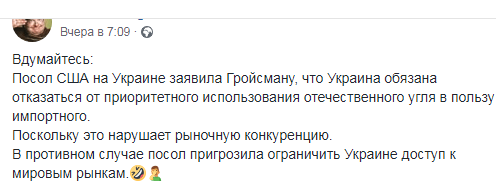
Strana learned that the US Ambassador to Ukraine Marie Yovanovitch wrote a letter to the Prime Minister Volodymyr Hroysman, in which she asked [the government] to “reject the idea of the Ministry of Energy and Coal Industry regarding the priority of purchasing electrical energy that was created using domestic coal (of the gaseous group) over that which was created using imported (anthracite coal).”
The ambassador puts forward the argument that last year the Anti-Monopoly Committee of Ukraine already blocked a similar project as a discriminatory and deterring competition on the market.
It says in the letter:
“We think that this suggested decision would in fact restrict the country’s access to diversified sources of energy, and that’s why it will weaken [her] energy security.”
It is apparent that [the letter] talks about imports of coal from the US, which has already acquired a name in Ukraine: “Pennsylvania plus.”
In the letter it is, in fact, clearly suggested that “Pennsylvania plus” can, just in case, be cut off.
“Last year we celebrated Ukrainian purchase of coal from the US as a step towards energy security of your country. And the measures, that are currently being looked at, are seen as restricting Ukraine’s access to global markets.”
By the way, in 7 months of the current year, the share of anthracite from the US was 31% out of all coal imports. According to the scheme, “Pennsylvania plus”, [the Americans] have delivered 0.5 billion worth of coal.
It is also said in the letter that [giving] priority to the use of Ukrainian coal could cause the electrical energy to be more expensive, and would force the companies using electrical energy to limit their production of energy. This would lower the attractiveness of the Ukrainian energy market and could abort the privatisation of “Centrenergo”.
The authenticity of the letter was confirmed to us by the president of the Independent Union of Miners, Mikhail Volynets, who also posses an identical copy of the letter.
Interestingly, on 26 October there was a government meeting the topic of which was coal industry. According to Volynets, the protocol decision of this meeting has emerged, the copy of which is also in possession of Strana.
The document contains the recommendation of the Prime Minister Volodymyr Hroysman to the Minister of Energy Nasalyk to take immediate measures to correct the situation until the end of this year.
Among the measures, the Ministry of Energy would within a week (which in fact ended last week) prepare a project of an act about the definition of priority of Ukrainian coal for the production of electrical energy.
The president of the Union of workers of the coal industry, Victor Turmanov who was presented at the meeting on 26 October confirmed to Strana they were promised money for modernisation of the shafts.
“We have asked for 4.8 billion hryvnia for the next year. In the projected budget there is only 650 million for liquidation of the shafts (the reform plans to close unpromising shafts) and 1.6 billion for everything else”
According to his words if the money is received, in seven months we can expect increase in production from 11 thousand tons per day to 30 thousand tons.
“It will not happen sooner because we need to buy machines and go through modernisation.”
According to Turmanov the purchase of domestic coal is more lucrative because the imported coal is more expensive (currently the price is 110 dollars for a ton, and the price will only grow). But in order to switch to gaseous coal of the “G”mark, which is being mined in Ukraine, from the imported anthracite, the boilers would have to be refitted.
The situation at shafts is very tense. People did not receive their salary for several months.
***
Earlier this blog reported Ukraine plans to buy 72% of her imported coal from Russia in 2019.

