You Should Absolutely get Paid to Protest

Two recent stories from Ukraine (where else?) have prompted me to write down my opinions about street protest. In Kiev, people were offered 130-150,- HRN ($5,- USD) per hour of protest “against payed protests”, and they failed to get paid. In Odessa, people were offered a staggering 1000,- HRN per hour, and when they turned up on the main square there was nobody to greet them. You might be feeling a bit of a schadenfreude now but I will tell you why you should always demand compensation for your time in the cold.

  1. Street protests are more often than not organised in service of entities with resources that your poor ass will never see. Take for instance the Maidan, initially organised by Mustafa Nayem, a known grant eater. Mustafa is getting paid by the United States, and the European Union. The Maidan also had sponsorship of the oligarchs, those guys are billionaires. And you don’t even get your 150,- HRN?
  2. Protests are usually to the benefit of a small clique of puppet masters that you have no relation to. At the end of the day, the puppet masters, and the leaders of the protests will reap the benefits, and you will either have fond memories, or a lifetime injury. In fact, if the risks are greater, you should demand much more than the measly 150,- HRN, which in my opinion is a pisstake.
    Let me give you an example. When the USSR stopped supporting the Social Bloc countries, the Czechoslovak secret service let Václav Havel out of jail in May 1989. For several months the latter organised the opposition, which came out on 17 November. Some of the secret service guys, and members of the nomenklatura, went on to become very rich. Many people who protested, in many cases against the party and the secret service, had their heads cracked.
  3. A street protest is an illusion. Its purpose is to create a semblance of popular support, where there may not be any. The latter is certainly true of the various types of “masovka” that we see in Ukraine in the run up to the presidential elections. People should be realistic, most of the favourites are very rich people with even richer people and entities behind them, it’s not immoral to ask for compensation.

So, the moral of the story is, never sell your ass short! Demand payment! Demand payment in advance! Know that you may be there because you believe in the bullshit but the organisers are getting paid.

StopFake.org Fears the Truth

From my trolling adventures…

StopFake.org is a project started by the Kyiv Mohyla Academy, which is called to fight disinformation. But I bet in reality they are around to produce an absolutely substandard media product, and gain grants from the EU and Ukrainian taxpayers among other people.

So they featured Jakub Janda:

DznoQaCX0AA2Ydu.jpg
Jakub Janda: StopFake has singled Russian Disinformation as the main threat to the global agenda. (whatever the latter means, be sure that StopFake and Janda are both on the payroll of the “global agenda”)

And I could not help myself, and had to tell them the truth about Jakub Janda. Janda is a homosexual pornstar, a plagiarist, and he was expelled from university for the latter offence. I am still baffled how somebody with such a biography gets to be a general of the information warfare against Russia. A rumour I heard from an insider has it though, that a large faction in the Czech Ministry of Foreign Affairs is held by a homosexual mafia.

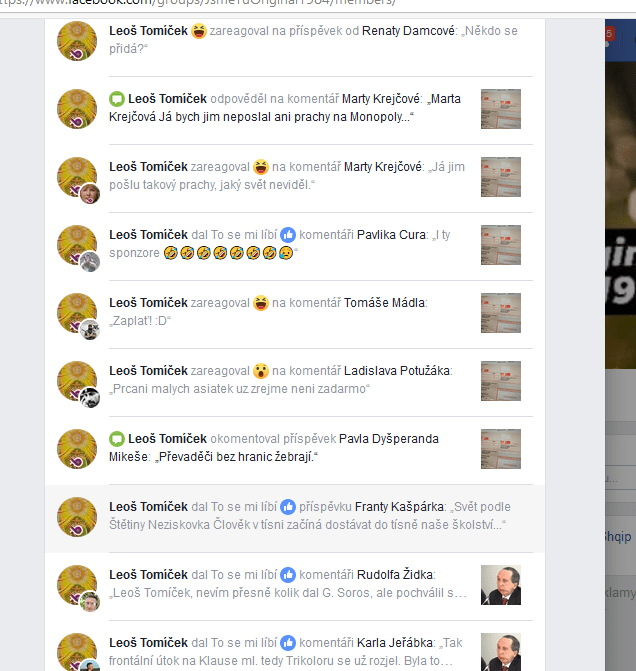
Anyway, I was promptly blocked by the chief of StopFake:

Screenshot 2019-02-17 at 19.57.36.png

In the Gas War, Ukraine is the Loser no Matter who wins

What is the gas war?

Roughly speaking, it is waged between Russia, who wants to export gas to consumers in Europe, and America, who wants to export their liquified natural gas (LNG) to consumers in Europe. There is a European consumer called Germany, who needs a lot of gas. The Germans have gone nuts, they want to replace coal and atom with windmills and mirrors. But meanwhile they need the low emissions natural gas to meet the targets they set themselves.

Some pro-Ukrainians believe Russia builds pipelines to bypass Ukraine, and thus deprive Ukraine of the revenue she makes from transit. Some hotheads out there believe Russia would then be less inclined to respect Ukraine’s territorial integrity, and war in the east may resume. But they are fooling themselves if they think that current America’s pressure on European countries to halt the Nord Stream 2 pipeline is in any way intended to help Ukraine. America’s goal is to be the sole exporter of LNG to Europe, and Washington is attempting to use its political influence to achieve this goal. For this purpose, LNG infrastructure is being built around the Baltics.

15282900579396.jpg

Source

Where exactly is Ukraine in this scheme of things?

Bellingcat says Ukraine has a Nazi Problem

We have been told ever since 2013 that the claims of neo-nazi presence in Ukraine is overblown, and part of Kremlin hybrid warfare information campaign to discredit the Maidan regime…

But what do we have here? Bellingcat finds Nazis in Ukraine because the latter have been building contacts with ideologically similar individuals in the West.

Bellingcat has confirmed that in January 2016, Azov, via its online podcast, was in contact with the late Andrew Oneschuk, an imminent member of the violent American neo-Nazi organization Atomwaffen Division. On Azov’s podcast, Oneschuk discussed issues facing Americans that wanted to join Azov, and expressed interest in learning methods of attracting youth to nationalism in America. He was encouraged to try to join Azov.

In another previously unreported case from the autumn of 2018, the political wing of Azov, the National Corps, supported an effort by Joachim Furholm, a Norwegian citizen and self-described “national socialist revolutionary,” to bring American right-wingers to Ukraine to fight against Russian aggression. The effort specifically framed participation in Ukraine’s war against Russian aggression as an opportunity for American right-wingers to acquire combat and other practical experience to be deployed later within the United States after returning home. Furholm also spoke at a political rally held by the National Corps in front of Ukraine’s Parliament in September 2018.

Evidence uncovered by Bellingcat points to recent contacts between the National Corps and alleged former U.S. armed services members who are currently in Ukraine. In one instance, an alleged U.S. Army veteran named “Alex” made an appearance on an American white nationalist podcast to comment on the ease of joining the war in Ukraine. Also, an alleged U.S. Navy veteran, “Shawn Irwood,” is currently enlisted in the Armed Forces of Ukraine and maintains contact with the National Corps. Shawn had stated his intention to join the Azov Regiment online, and was linked to the aforementioned Joachim Furholm prior to arrival in Ukraine in early 2018.

The International Secretary of the National Corps, responsible for Azov’s global strategy, told Bellingcat that the movement sought “all potential sympathizers” and “potential lobbyists” in the U.S., and hoped to “establish contacts with the American military.”

Screenshot 2019-02-16 at 14.42.26.png

Andreas Umland to the rescue with the trope about the low electoral support for Azov’s political ambitions. This is commonly used to create the illusion that the Ukrainian neonazis are anything important. I have discussed this argument before (I must say I am not very proud of that post). My explanation is as follows:

  1. Ukraine is a large country and you need large financial and human resources to score victory in the elections. The Azov leader, Biletskiy, is in the parliament as an independent.
  2. The major parties, and the general public in Ukraine, seem very accepting of the Ukrainian nationalist programme. That is Derussification and the Bandera cult.
  3. Many small nationalist parties may deprive each other of votes, and there are quite a few small nationalist outfits in Ukraine.

Amnesty International says Ukraine has a Nazi Problem

The human rights organisation Amnesty International has produced a report, where they criticise human rights violations in Ukraine.

I quote:

2018 was marked by a sharp surge of violent attacks against a range of individuals and groups, often in the name of patriotism and “traditional values”. Those subjected to violence come from different walks of life, and include journalists, human rights defenders, especially those working on women’s rights and the rights of LGBTI people, members of ethnic minorities – particularly Roma – and those whose political views the attackers regard as “pro-Russian”. In almost all instances, the law-enforcement authorities have been slow to react and perpetrators were rarely, if ever, brought to justice. The Ukrainian authorities have not explicitly condemned the violence, while those who perpetrate it have continued to enjoy near-total impunity. Moreover, allegations have been made by various commentators in the media, including on social media, regarding financial and other support these groups may be receiving from certain members of the authorities. Altogether, this has contributed to a feeling among the human rights community in Ukraine that members of these groups are often deliberately allowed to be above the law. This also has a chilling effect on members of Ukraine’s civil society and has discouraged them from holding or taking part in public events, and has reinforced the intimidation sought by the far-right groups who attack the relevant events.

Pro-Western Orientation Makes Ukrainians Unhealthy

As you probably may have heard, Russian trolls spread measles…

And it looks like the Ukrainians are champions in the current epidemic of measles. Anatoly Karlin featured an interesting infographic that I repost:

Screenshot 2019-02-14 at 22.55.17.pngYou can see the immunisation dropping around 2008, which marks the mortgage crisis. It looks like the Maidan monkeys invested all their beads into the US economy and crashed with it. Obviously, the plebs was made to pay for it.

Yanukovych managed to bring it back a little only for another present from our friends across the Atlantic, the Revolution of Indignity, making it drop again.

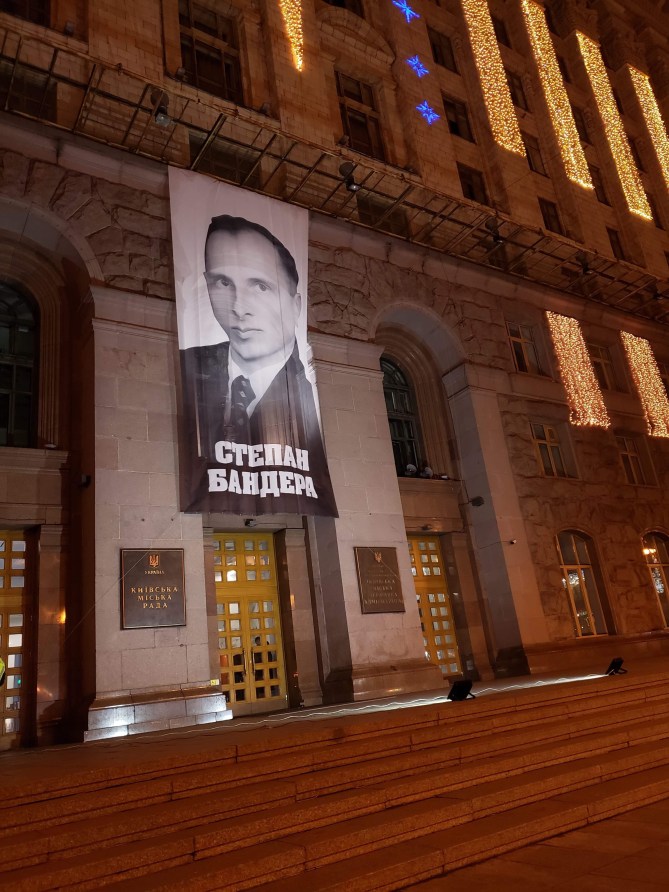
Bandera was a Fascist, Sorry!

There is a serious problem with Ukraine’s fascist hero, Stepan Bandera. 

Bandera was a son of a Uniate Priest from Halychyna, who collaborated with the Nazis in their invasion of Ukraine. Let me expand on this statement, Halychyna was a part of Rus’ occupied and perverted by the Poles from the fourteenth century, and their identity developed in a peculiar way, towards the alienation of local identity from the rest of Rus’, and Bandera was a product of this culture, and he collaborated with the Nazis in the invasion of Soviet Ukraine, and my great grandfather fought against scum like this.

Bandera was given a new life by the Anglosaxons, who saved his followers from justice. His cult was transplanted to independent Ukraine like a virus. In order for Ukraine to become a normal country, it will need to be denazified. I don’t know who will do it, will it be East Ukrainians, will it be Russia, will it one of the oligarchs, and I don’t know when or how it will happen. But I am sure it will happen.

Retarded Sovok Boomers Against The Ukrainian Passports of Crimeans

The head of the Crimean parliament is a Sovok Boomer…

Vladimir Andreyevich Konstantinov is old as fuck my father’s age, and he is stuck up. Here is a translation of his words:

“You need to make a choice -we have made a choice in 2014, there isn’t any point to go there [to Ukraine] to seek these passports. Who needs them? Decide who you are in life, are you smart or handsome (why not both?). But running here and there -getting all the privileges of Russia, and have something over there just in case -we need to stop this craftiness.”

What is the deal here? The Crimeans have been getting Ukrainian biometric passports to take advantage of Ukraine’s visa-free regime with the EU. According to Ukrainian sources, it is thousands of Crimeans every year.

I do understand the certain security concerns of the Russian state but they need to understand that the privileges of Russia do not contain visa-free travel to the West, or even the possibility to obtain a visa because the territory is blockaded by the West. And I am of the opinion that if a state gives, you should take. And the Crimeans can fleece both the RF and Ukraine at the same time.

Sovok Boomers like Konstantinov would do better not to comment on this because they give the whole issue publicity. But they definitely should monitor this activity.

An interesting commentary from a lawyer from Crimea, Zhan Zapruta:

The Crimeans have a peculiar status, they have both Russian and Ukrainian citizenship. If the Crimeans do not want to drop their Ukrainian passport, they cannot be forced.

How Kuzio Denies the Plight of Russian Speakers

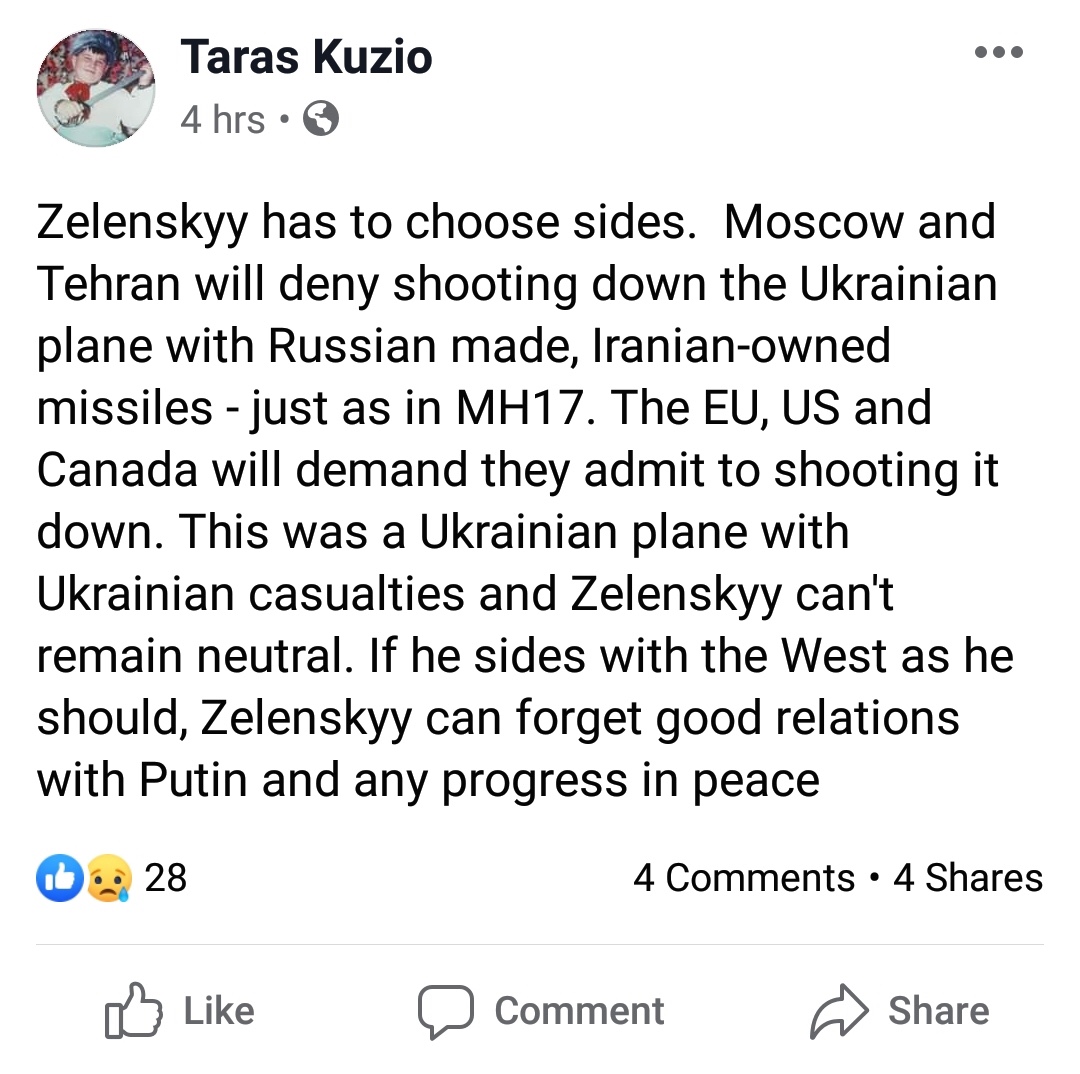
This post will dissect Kuzio’s recent drivel on Facebook…

It has become a sort of a tradition of the Ukrainian pundits to attempt to deny the plight, and rightful grievances of the Russian speakers, who rebelled against Ukraine in 2014. And another tradition, particularly in Western academia, is to frame discourse about Ukraine using the language of decolonisation studies, and Western leftist narratives of power.

…these Russianists provide an Orientalist analysis of Ukrainian developments by looking at the Crimea and Donbas through the eyes of the former imperial power and the state undertaking military aggression against Ukraine.

I have even seen academics refer metaphorically to Ukrainians as black, and Russians as white colonists. This is a grave overstretch of reality but it sells in the West.

Jesse Driscoll’s article in Ponars is an example of this academic orientalism. His article is based on the wrong assumption that Ukraine has a language problem – it does not. Driscoll, similar to other Western Russianists, do not bother with opinion polls which show only 1-2% of Ukrainians who believe Russian speakers have problems in Ukraine.

The issue of the Russian language is a complex one. And so is the understanding of what a Russian speaker is. As I mentioned on this blog, Russian is likely the most used language in Ukraine. However, the identity of its users is a complex one. You have people, who identify as Ukrainians, consider their native language to be Ukrainian, but use Russian almost exclusively in daily life. There are also Ukrainian people, who consider their native language to be Russian, and they have always been a minority. Furthermore, there are also people, who consider their ethnicity to be Russian, and they are an even lesser minority. My recent post, shows the results of the 2001 census represented geographically.

What does Driscoll therefore mean when he talks of the “valid concerns of the Russian-speaking population” when the evidence from the war and opinion polls shows they have no concerns on the language question and why is he repeating Moscow’s framework for understanding the war?

Kuzio does not reference any of the polls he mentions but the problem of Russian speakers, or what I like to call, the “Russian element” is somewhat more complex than just the issue of the Russian language, which is clearly being discriminated against in Ukraine. The issues also include economic ties to Russia, and historical memory which is under threat by the ubiquitous rehabilitation of the radical interbellum nationalism, that is Fascism and Naziism.

If the Russian speakers didn’t have any concerns, where then did the anti-Maidan, the Russian spring, and the rebellion in the Donbass come from? Ukrainian pundits would want to say it is all Russia’s fault but that’s rather lame.

Driscoll writes that he is “doubtful that those forces could survive autonomously” without Russian support. He is correct which is why they are best labelled Russian proxies and the war cannot be classified as a “civil war.”
In Spring 2014, Russia transformed anti-Euromaidan protestors into an armed insurgency through provision of intelligence assets (throughout the Euromaidan Revolution), Russian mercenaries who took up leadership positions in the DNR and LNR (most of whom were Russian neo-Nazis in February-March 2014), Russian special forces in Aril 2014, Chechen Kadyrov mercenaries in April-May 2014, Russian artillery firing into Ukraine in July 2014, and outright Russian invasion in August 2014. Between Minsk 1 and Minsk 2, Russia transformed its proxies into a 35, 000 army consisting of two corps within the southern Russian military district.

The Ukrainian state in Donetsk and in the Crimea collapsed without the help of the Russian military because of local protest against the Maidan putsch.

The debate whether the rebels would have survived without Russia is meaningless. Why is it wrong for a foreign power to support an independence movement of friendly people? Didn’t the French support the British colonies in the Americas in their fight for independence? Wasn’t the United States essentially like LNR and DNR in its time?

Kuzio also makes other meaningless and misleading arguments:

Driscoll’s assumptions and framework ignores the large number of Russian speakers fighting and dying for Ukraine. It ignores the fact that the eastern Ukrainian Dnipro oblast has the highest casualties of security forces. Putin’s military aggression against Ukraine is killing and displacing Russian speakers.

Driscoll writes about Spring 2014 without showing a grasp of what transpired. Ukrainian Security forces partially defected in the Donbas and fully defected in the Crimea, but nowhere else. Ukrainian security forces in the two crown jewels of eastern and southern Ukraine – Kharkiv and Odesa – and elsewhere remained loyal to Kyiv.

Do I detect a case of contradiction? On one hand the Kuzio confirms Ukrainian military has defected in the mutinous regions but Ukraine does not have a civil war because Russia helped these rebels? How does that work?

Another case of dishonesty is when Kuzio mentions Dnipro (former Dnepropetrovsk) volunteers. If you refer back to the link about the 2001 census above, you will see that in the Dnepropetrovsk region, people who identify as Ukrainians predominate. People, who consider their native language to be Russian predominate only in Dnipro. And that’s 2001 we are talking about, the situation has likely changed since then thanks to the work of local rulers, Boris Filatov and Genadiy Korban.

Donetsk on the other hand is much more Russian, linguistically and ethnically, and the Russian identification is not just limited to the regional capital. It should also be added that the Donbass attracted many fleeing the repression of pro-Russians in other regions.

Nearly 2 million Ukrainians have fled from the Donbas and 1.7 of these Russian speakers fled to Ukraine. Jews, who are also Russian speakers, have also fled from the Donbas to Ukraine.

Perhaps a part of the population likely identified more with Ukraine, and quite frankly, life in an internationally unrecognised territory managed by Vladislav Surkov certainly isn’t for everyone.