
EXPECTATIONS

REALITY
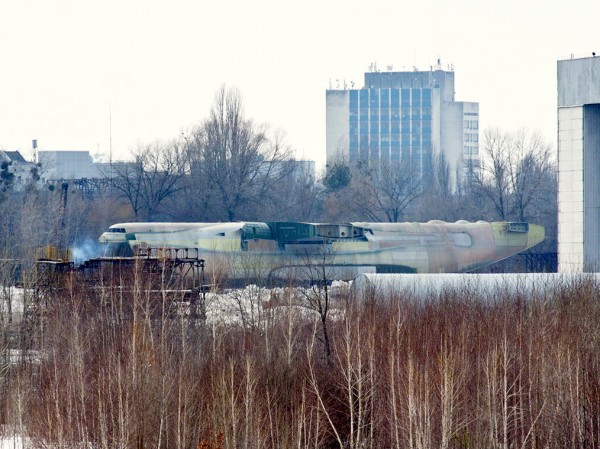
Taken from Peremogi
Would they picket a forum, where people present in English? Why shouldn’t guest speakers not use a language that everyone understands? Should provincial nationalism stand in the way of modern business?
Strana.ua reports…
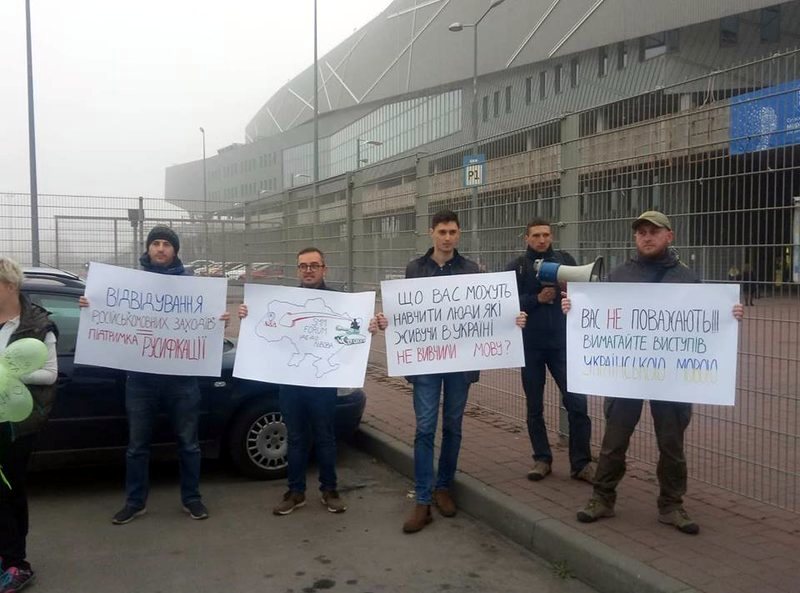
A forum conducted in the Russian language was picketed in Lvov. Vgolos (a disgusting Russophobic dump) reports.
20 people stood around “Arena Lvov” and picketed the LVIV SMM FORUM IV. (а social media marketing forum). The organiser from “Lvov ne govorit po russki” Andrey Syvokhip said that he has been fighting for several years to make the lecturers translate their presentations into Ukrainian. But he is being constantly ignored.
“It is not the first year, the Russophone SMM Forum takes place in Lvov. I have constantly asked the organisers to provide a translation of Russian language lectures into Ukrainian. When I found out that on 20 October, there will be another forum in Lvov, I began writing to the organisers of the event regarding the language of the lecturers. They however did not want to speak to me.”
Syvokhip said that he wrote about this problem to Lvov mayor, Andriy Sadovy but did not receive any answer. The organisers of the forum refused to provide a simultaneous translation into Ukrainian.
“On Tuesday I wanted to buy a ticket for the event. I was told there will not be a simultaneous translation into Ukrainian. Out of all the lecturers, only one agreed to present in Ukrainian, and the rest categorically refused to change their presentations. I think the organisers of the forum a limiting a large number of people, who do not know the Russian language or do not absorb information in this language.” (the latter are clearly handicapped)
Syvokhip remarked that many participants of the SMM Forum have discovered today for the first time that the presentations will be exclusively in Russian.
“The participants in the SMM Forum, entering the “Arena Lvov” have told me they don’t know which language the speakers with use. Many people said that if they knew the event was in the Russian language, they would not attend. (yet they did attend) The organisers have completely refused to talk to us.”
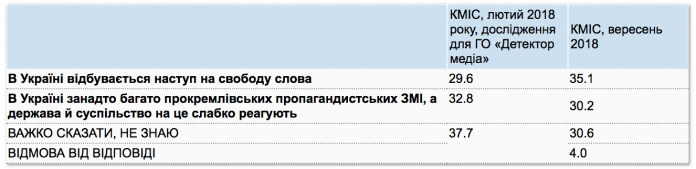
In September, the Kiev International Institute of Sociology conducted a curious poll, and here are the results…
35.1% think that freedom of speech is under attack.
But 30.2% also think there are too many pro-Kremlin propaganda media and the state and society react rather weakly to it.
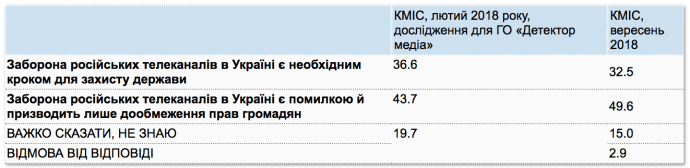
32.5% think the banning of Russian TV channels is a necessary step in order to protect the country.
However, 49.6% think banning of Russian TV channels was a mistake and only leads to restrictions of the rights of citizens.
Similarly, 26.6% of the respondents thought banning certain Russian performance artists and films is a step necessary to protect the country
56.7% think banning Russian performance artists and films is a mistake and restricts the rights of citizens.
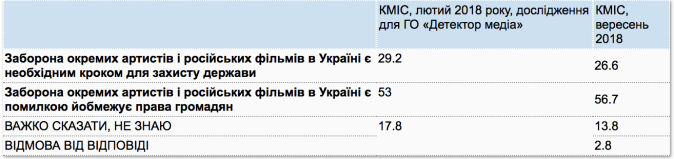
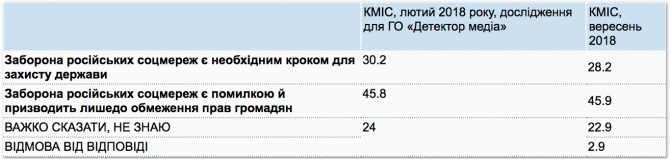
28.2% think ban on Russian social media websites is a step necessary in order to protect the country.
45.9% think banning Russian social media websites is a mistake and leads to restriction of the rights of citizens.
37.2% of the respondents support linguistic quotas to support the Ukrainian language on radio and TV, while 40.2% do not.

The hero of Maidan, and Rada member, Volodymyr Parasyuk said there will be another Maidan because gas prices are being increased by 24%.
Watch the video, it has my subtitles…
I don’t know if it is my poor knowledge of Ukrainian, or the fact that Parasyuk speaks badly but I tried my best. Don’t forget to follow the video, and subscribe to my channel.
Prasyuk has a small problem though. Maidan requires…
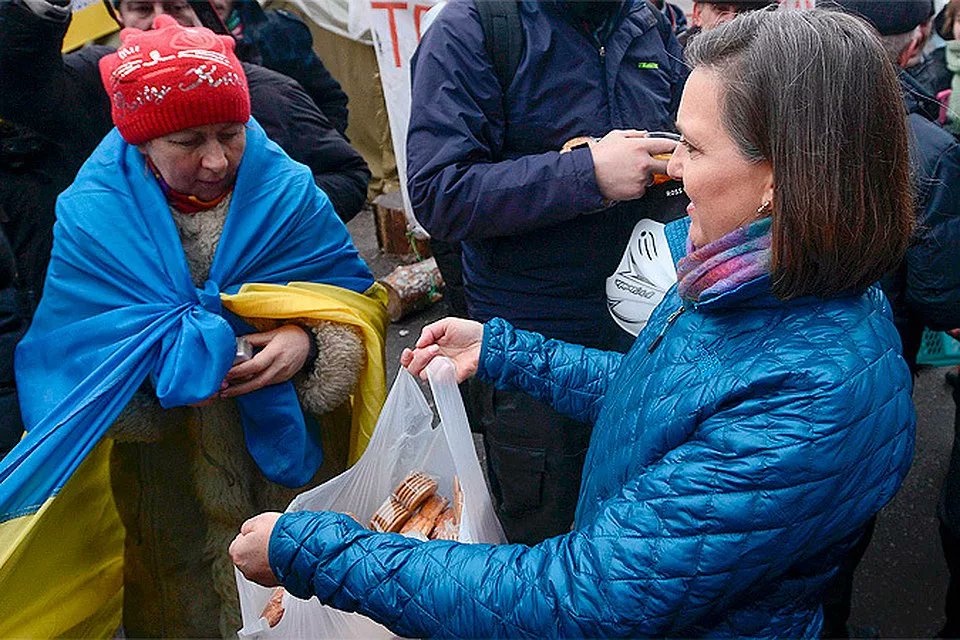
No, not pastry! The blessing of Murica!
By the way, gas costs 12 times less in DNR.
From Pershy
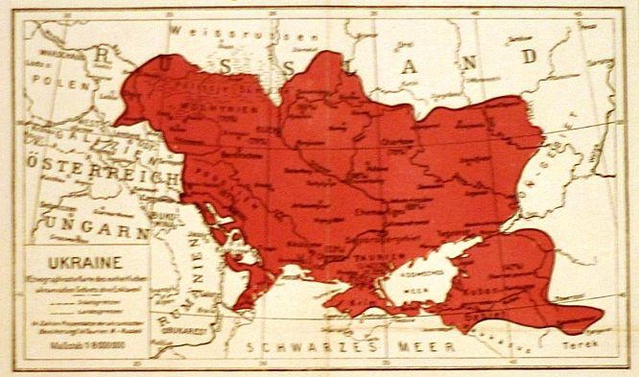
Kiev City Council renamed the Marshall Zhukov Street, in the Desnyansky District, to street of Kuban’ Ukraine.
The Press Service of the Kiev City State Administration reported.
“New name was chosen to renew historical memory of the Cossack state formation in the Kuban'”
The street was built in 1960 and was named Poligrafichna (because of a Research centre of the polygraphic industry located in its beginning).It received the name in honour of the soviet military leader Marshall of the Soviet Union, Georgy Zhukov in 1974.
Kuban’ Ukraine, Kuban’ People’s Republic, after that Independent Kuban’ People’s Republic (16 February 1918-1920) [was] a Cossack state formation in the Kuban’, she existed for a year and nine months.
The first constitution of KNR proclaimed its lands to be composed of the Black Sea Gubernia, Stavropol Gubernia, and Terek Gubernia.
[On] 23 January 1918 the Lawgiver Council of the Independent Kuban’ People’s Republic passed a resolution about joining the Ukrainian People’s Republic on a federative basis. However, due to aggression of Soviet Russia this merger did not happen. On 17 March 1920, the Kuban’ Republic was destroyed by the bolsheviks.
On 12 October, the Kiev Council renamed the Mel’nikov Street, in the Shevchenko District of Kiev, in honour of the film director Yuri Illenko.
In the Solom’yans’ky District of the capital, the Mechanizatoriv Street was renamed in the honour Maksim Shapoval, intelligence office who died as a result of a terrorist attack.
Why Ukraine can, and Russia cannot…
My home country, the Czech Republic has long removed red stars, statues of Lenin, and painted Soviet tanks pink, and today it is ruled by a party headed by former Communist secret service collaborator in coalition with the Communist Party. While the foreign element of Soviet Communism was easily purged out of the streets, the mentality which elected Communists in 1946 did not go away. Some things take longer to die.
Statues of Lenin were an element of a foreign culture in Czechoslovakia, a cargo cult of the local Communist rulers. In Ukraine however, the symbols of Communism were very much an organic part of the landscape. Although, today Lenin will not get much credit for it, he made a profound contribution to the formation of the Ukrainian state. He asserted Ukraine’s control over South-Eastern territories, and instituted a programme of Ukrainisation, which was crucial to the creation of the Ukrainian nation.
One snowy evening in December 2013, some twenty three years after Ukraine gained independence from the Soviet Union, a group of masked Ukrainian nationalists knocked a marble statue of Lenin at the Bessarabskaya Square in Kiev off from the pedestal. The perpetrators sang the Ukrainian anthem, said Russians ought to be knifed, and gave very lame historical accounts on camera. It was a group of fanatical lumpens, which have used the weakness of the state to topple an idol they came to despise. They reminded me of a Christian mob in Late Roman Empire doing away with a pagan shrine.
After the Maidan victory, the Ukrainian state found new strength and vigour in, what Pavlo Klimkin recently called, the “spirit of the struggle“, and began a state run campaign of “Cosmetic Decommunisation” and “derussification”. I propose to call this “spirit of the struggle” SUHS, short for: “Slava Ukrayini, Heroyim Slava!” -which was a greeting among the Ukrainian Insurgent Army, inspired by “Heil Hitler, Sieg Heil!”, and the slogan has now become the official greeting in the Ukrainian Army. SUHS is the new heroic idol that will replace the Bolshevik gods. And anything even closely approaching SUHS is absent in Russia.
Don’t get me wrong, I do not suggest Russia ought to adopt anything like SUHS, SUHS is a primitive and hateful ideology, a symptom of Ukraine’s social and cultural decay. SUHS has brought war into Ukraine. However, those who wish to decommunise Russia need to develop an ideology that will replace the Communist pantheon of heroes. It would need to be something a person with a two digit IQ will understand, very much like SUHS in this respect. And this is made harder by the fact that the only heroic event modern Russia commemorates is the Victory in Second World War, called “Great Patriotic War” in Russia. It is telling that the anti-Maidan forces in Ukraine have adopted the “George’s Ribbon”, a symbol of the “Great Victory” holiday. The victory is inseparable from Communism and Stalin.
Natal’ya Dembinskaya for RIA reports…
Starting November, Russia will quit supplying Belarus with gasoline, diesel and fuel oil, the restrictions will last until the end of next year. The Ministry of Energy said that export of oil products to Belarus is impractical, the republic [of Belarus] fully provides for her need in oil products though processing of Russian oil. Minsk does not need the surplus, the ally [of Russia] sells them to neighbouring Ukraine, making billions of dollars. Observers remark that the volumes of reexport have reached such a scale that Moscow could not leave it without attention.
More than is needed
The Russian Ministry of Energy has clarified that imports of certain oil products not made in Belarus will remain. The restrictions [imposed] will also not touch oil exports. In 2019, Russia will export 24 million tons of oil to the neighbouring country, just as much as last year.
What concerns gasoline, fuel and fuel oil, the indicative balance indicators provided are zero.
The Belorussians have imported 2.3 million tons of oil products for 900 million dollars from Russia. It is apparent that the actual need of the republic [of Belarus] is far lower. In contrast, five years ago [Belarus] imported 90 thousand tons of oil products from Russia.
Everything that Belarus did not use herself was actively reexported – the main volume of it went to Ukraine.
The Belorussians are not happy
Ending imports of oil, oil products and gas in volumes over those needed for Belarusian consumption have been debated for quite a while. Now a decision was made, and the calculation is simple. New agreements make grey schemes with imports of oil products, within the framework of the Union State, that lead to shortfalls for the Russian budget, impossible.
The Belorussians do not agree with this position. In August, [Belorussian] president, Alexander Lukashenko said in an interview to Belarus-1 TV channel that he does not understand reproaches against Belorussian companies that they buy shady oil products, process them in Belarus, and then sell them on foreign markets. The head of state said this is not a new practice. And shady oil products are, in his words, oil products not realised in Russia, processing of which makes Belarus peanuts.
But the talk is not exactly about peanuts.
And independent economic expert, Anton Shabanov says “Belarus was not making bad money; to buy for two roubles and sell to neighbours for five was the official position of the government.”
As Neighbours
In recent years the volumes of such imports were growing with a geometrical progression. Belorussian economists have calculated that Belarus made 5% of her GDP on reexport of oil products.
“Russian, Ukrainian, and Belorussian people have always been united, overlooking all differences, by an understanding. The understanding was in Belarus is a comfortable channel for reexport.”
-Alexey Gromov, director of Energy direction of the Institute of Energy and Finance
The expert suggests that the channel was for the time being closed in a trial regime. However, if the Belorussians provide convincing case that they need more of our energy resources for [their] economy, the restrictions could be reconsidered.
“This is a wise, preventive measure, we do not want to help another country to our own detriment. The Ukrainians can buy oil somewhere else if they do not want to buy from Russia directly. The fact that we are loosing significant amount of money became very apparent. Ignoring this became uncomfortable”
-Dmitry Adamidov, independent analyst
They will have to pay more
The coming ban on the export of oil products promises to be felt by the Ukrainian market of oil refinery products. According to some date, Ukraine covered 40% of her motor fuel needs by Russian oil reexported by Belarus. Advantages for Kiev are apparent: expedient logistics with almost direct deliveries and good prices.
“The Ukrainians are not threatened by a physical deficit, there are plenty of oil products on the market. The difference from the cheap grey scheme (Minsk got the oil products tax free within a Customs Union) is that imports from alternative sources are more expensive, they will have to deal with market prices.”
Economists think that one of Belarus’ closest competitors, for example Kazakhstan or alternatively European neighbours, may try to substitute the missing Belorussian imports.
Alexey Gromov thinks: “Ukraine buys alternative gas in Europe for a price that is ten to fifteen percent higher than the Russian price, the same will happen with oil products.”
As you probably may have heard, the notorious internet content producer Graham Phillips gave Bandera’s grave in Munich a facelift…
Graham was trying to bring awareness to a shrine to fascism in the midsts of a Bavarian forest…
Please follow the video, and subscribe to my Youtube channel, where I publish videos relating to this blog…
On the way, Graham encountered a group of pilgrims. He shouted: “Steednow! Steednow!”, which is supposed to say “Shemeful! Shameful!”
The Pilgrims were very shy but Ukrainian politicians were very triggered over what happened. Igor Mosiychuk, parliament member from the Radical Party said:
“This monster (i.e. Graham Philips) needs to live in constant fear because if the police does not come for him, Ukrainian nationalists will visit him.”
Graham called Mosiychuk a “rotten bastard” on Twitter, and added that Mosiychuk’s words only motivate him to do more work to spread the truth.

The Ukrainian minister of foreign affairs was being particularly autistic on Twitter. He seems to have deleted the tweet below. It looked like written by a low IQ intern recruited from the ranks of Ukrainian online trolls. 
“The Russian Empire has fought against Ukraine, respectively against the UPA (note: Ukrainian Insurgent Army), and then killed S. Bandera (WUT? WUT?) and now is plundering his grave by the hands of provocateurs and propagandists [that she] nourishes. The spirit of struggle does not give them any sleep because it inspires us to progress forward! And [the event] will be judged by an impartial prosecutor’s office.”
I really hope they bring this to court because Grahams defence, and the attention it will get, is the last thing they want.
The following information comes from here. The article links to Vedmosti but that is behind a paywall and I am a cheapy.
The leading nation among buyers of so called “golden visas”, which allows the buyer to obtain a citizenship or a residence in exchange for investment, are the Chinese, they lead over Russians simply due to numerical superiority. In Latvia 70% of such investments come from Russians. Among the most popular destinations are Cyprus and Malta. According to Knight Frank, 58% of superrich Russians have a second passport of double nationality.
Transparency International and Global Witness claim that often countries do not monitor the origin of the money invested. The investors are mostly interested in passive assets like real estate, and do not invest in innovation and industry that creates jobs. This makes their contribution to local economy questionable.
Let me introduce you to the yin and yang of Ukrainian existence. All Ukrainian life oscillates between two concepts. “Velyka Peremoha” (Great Victory) and Hanebna Zrada (Shameful Betrayl). You will soon see how it works…
Hanebna Zrada has happened in the East Ukrainian town of Konotop, in the Sumy region, where veterans of ATO (“anti-terrorist operation” against the people of Donbass) have gathered to celebrate their Peremoha on the eve of 14 October, the foundation day of the Ukrainian Insurgent Army, which was made into a national holiday of the Defender of Ukraine.
TSN report:
The heroes of light have been greeted by a video featuring the suffering of Donbass people, and the heroism of Donbass rebels, which are banned topics in Ukraine. Here is the video:
The SBU (Ukrainian secret service) is on the case to reveal the perpetrators of this act of mental sabotage.
Materials for this post were found at Stalkerzone.
 Insomniac Resurrected