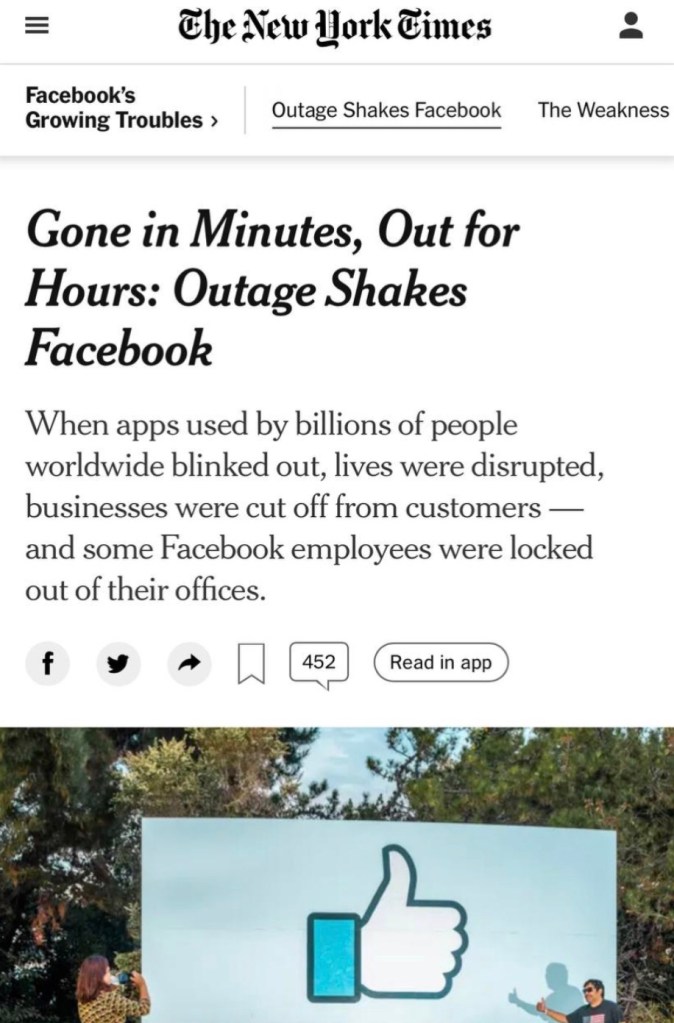
Yesterday, Facebook and other related services when out for like 6 hours. And it was beautiful. Why does New York Times present this as a tragedy?
I personally do not care what happened to Facebook employees. If you are Facebook employee, you should be ashamed but when read that businesses were cut off from customers…
My friends, if you have a business, a society, a political party, or campaign. Reliance on Facebook is the worst situation you can be in. It is only good when the machine works to your favour. Once it doesn’t, this reliance becomes hell.
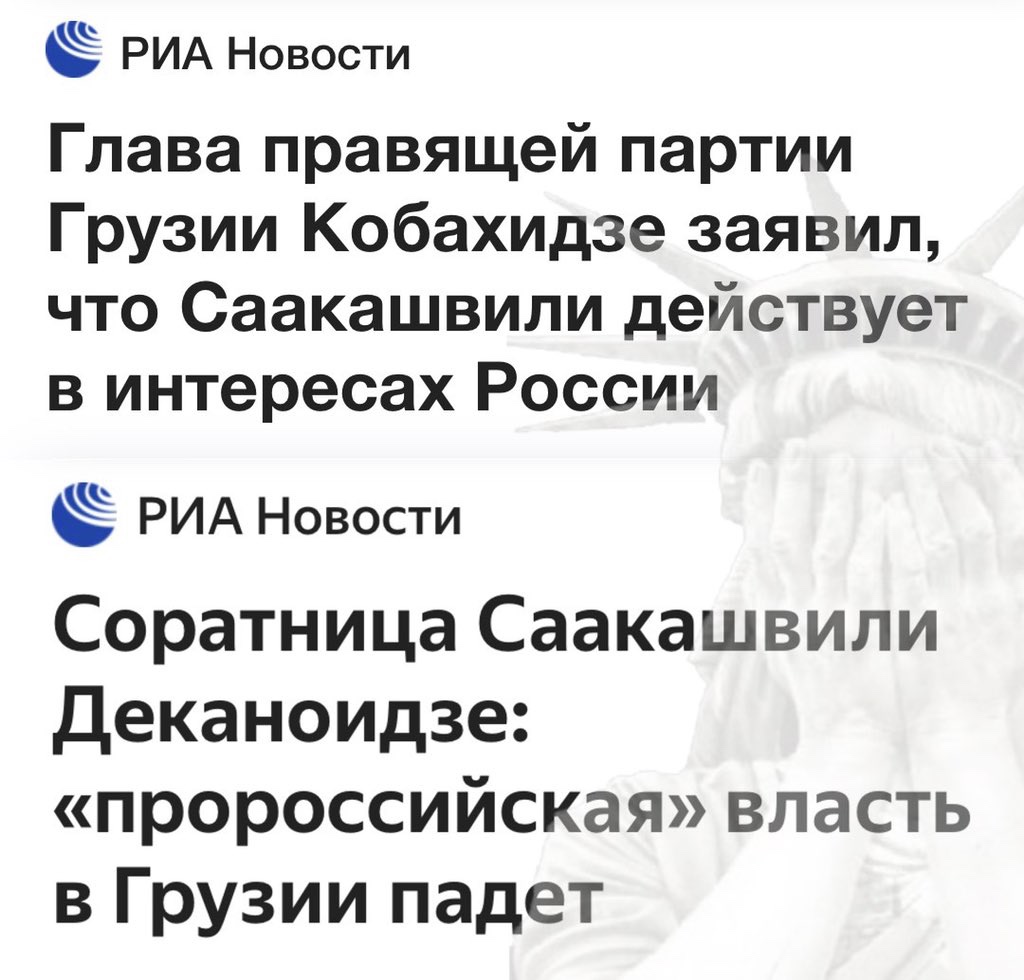
Watching Georgian politicians accuse each other of being pro-Russian is kinda cute…
Headline Above: “The head of Georgia’s ruling party, Kobalhidze said that Saakashvili acts in the interests of Russia”; Headline Below: “Saakashvili’s ally, Dekanoidze: the ‘pro-Russian’ government in Georgia will fall”
Mikhaïl Saakashvili recently returned to Georgia, probably in hopes that the “pro-Russian” government there will fall but the latter did not happen. Now he is in jail…
I sense it in the air, the North Atlantic alliance may soon unravel…
What leads me to believe this?
1) Former US president, Donald Trump was very critical about European countries not spending 2% of their GDP on defense as is their obligation under NATO treaty. Trump was reviled for almost everything under the sun, including his criticism of NATO allies but he was not lying. The Czech Ministry of Foreign Affairs even admits this in their foreign policy strategy. I would bet there are forces within the US establishment that are very unhappy about this.
2) The new US president, Joe Biden, who was supposed to repair transatlantic relations, recently announced the creation of AUKUS, an alliance of the three Anglo-Saxon countries, US, UK, and Australia. This apparently deprived the French of a contract to build submarines for Australia.
3) Macron has once said that NATO is brainless, and there is a talk on the European continent of the formation of an EU army.
4) Turkey has broken a tradition of buying American weapons and purchased Russian anti-aircraft S400 missiles. The US threatened to withdraw delivery of F-35 and Turkey said it may buy Russian made warplanes.
Could all these controversies compound eventually to cause a break in alliance?
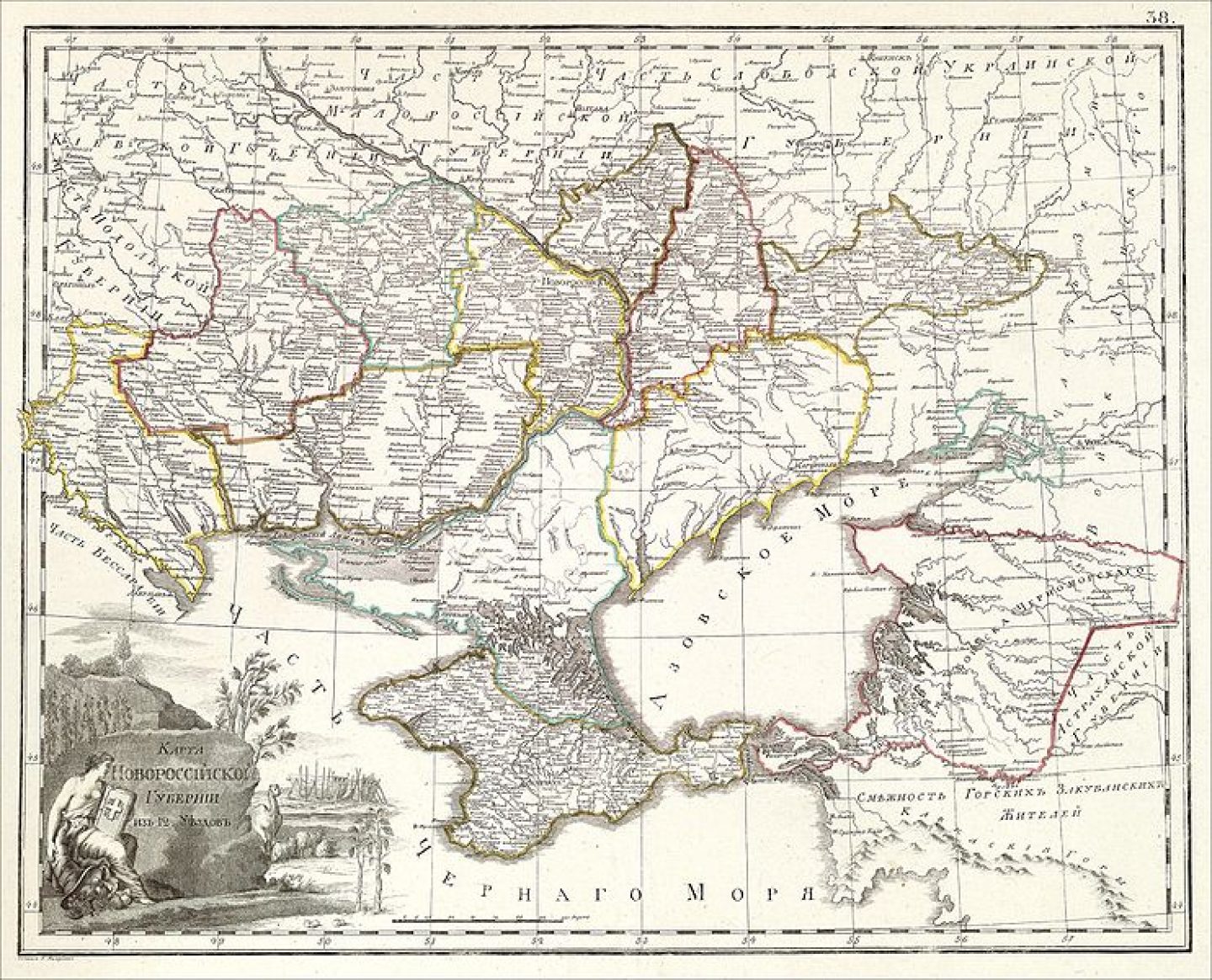
The years immediately after the victory of the Maidan, were literally the peak of Svidomism, particularly the first months of 2014. Back then Crimea was still half way on its way out, there was no war yet, and so we saw Svidomite bravado such as the one below:
Ukraine in 10-15 years. Investment from the EU and Marshal Plan (USA) – the entire country is a construction site: motorways, factories, a variety farms are growing like mushrooms here and there. Sun, grace, wheat fields in the steppes. Progress everywhere – monorail trains run from one corner of the country to another. The country is getting richer, we have the richest soil and the people are hard working, friendly and tolerant of others – everybody is happy. As if it were like in heaven.
Over Dniepr, over the capital Kiev the music of Bortnyansky is playing incessantly. The Ukrainian nation gives thanks to God for joy and peace through this music. And meanwhile, beyond a stone wall to the north nations of the prison empire are burning tires, they are taking a cue from Ukraine… and beat up the rashists. There is a rebellion in Crimea, they want to go back to Ukraine but they are being carted off to Magadan…
***
LMAO 🤣
It is almost ironic that it was Crimea that became a construction site with a new new airport, new highway, new railroad, and a new bridge linking to the Russian mainland. It is sad that the above drivel hides within it a recognition of the immense potential of Ukraine never been realized. Ukraine has a perfect geographical location and fertile soil, it had industry inherited from the Soviet Union. But Ukraine also has Svidomism and that’s why it was unable to make any use of those assets.
I just wonder, where do stupidities such as the belief that America, with it decrepit infrastructure, is going to build a monorail in Ukraine? Marshal plan was for Europe destroyed in the deadliest conflict in human history, not for a post-Soviet ethnic bantoustan destroyed by years of mismanagement. Many US cities do not even have a monorail. Meanwhile, instead of a monorail, Ukraine has old Soviet trains where mushrooms grow. But one needs to ask where does this imbecilic optimism come from?
Ukrainian mycorail
Even today, when it should be blatantly clear that no monorail will be built, Svidomites still dream of a return of Crimea and the Donbass. Just the other day, while trolling Sternenko on YouTube, some particularly gifted lady told me that Crimea will be returned when Putler dies. I simply do not know where such fantasies originate. Is it a coping mechanism? But quite frankly, I am betting that most people making such statements aren’t in any way benefiting from the state of things as they are.
Ukraine’s many ills are psychological. Svidomism is a disease of the mind, which turns one into a Russophobic moron, and leads one to act in self-destructive ways. It is not just Ukraine that is suffering from this. Bulgaria, the Czech Republic are also not immune to periodic explosions of Russophobic hysteria that goes against the interests of local economies. I am speaking about Bulgaria’s rejection of the South Stream pipeline, and the Czech Vrbětice affair…
These countries need to achieve healing, drop malign Western influence, apologize for Russophobia, and only then they will prosper in the long term…
Some people in Ukraine, particularly those in retirement find it hard to pay the utility bills. An old geezer marched into the offices of Chernigovgaz in the town of Chernigov and attempted self-immolation because his gas was cut off.
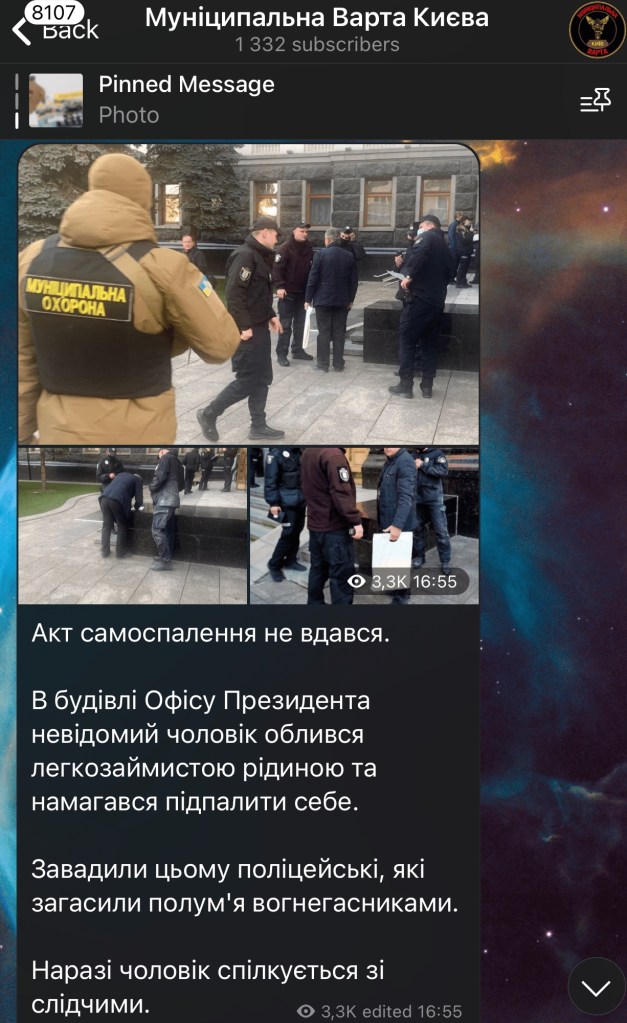
In other news, a man attempted self-immolation in the offices of the Ukrainian president in Kiev. He did not disclose the reasons for his desperate act.
Rappers with lyrics about bitches, hardcore sex and drug abuse find it ever harder to stage a concert in Russia. Concerned parents have cancelled planned concerts of Morgenshtern in 10 Russian cities.
Parent organizations have managed to cancel of the pornographic and satanic rapper in Novosibirsk, Orel, Krasnodar, Khabarovsk, and Vladivostok. Tsargrad reports that according to their sources, further five cities have rejected the rapper.
Russia is fast becoming a hostile space for adepts of a degenerate Western culture.
So, you may have seen what is happening in the UK with the truck drivers, there ain’t enough of them…
Out of the few jobs that I tried to do in recent years was work for a trucking company. I have seen the treatment of the drivers first hand, got angry and left. I was specifically tasked with recruitment and management of Ukrainian migrant workers, and I am not surprised nobody wants to do it.
In Britain, the situation with truckers became exacerbated because post-Brexit rules do not allow easy recruitment of drivers from the continent. The Covid pandemic also halted the issuing of new licenses. However, my first comment was that we Czechs are also not safe from such a situation because the share of foreign work force is also very high in our country.
I do not have the exact statistics for the Czech Republic but here I read in the Ukrainian online newspaper Stranathat in Lithuania, 80% of truckers hail from Ukraine and Belarus. Most of the natives doing this are old guys, who don’t know any better. This is the most unhealthy situation ever if one thinks that it is the truckers that bring necessities such as food and fuel, and the whole system could come crashing down if knocked a little, as happened in the UK.
The root of the problem is that driving a truck is a skill that requires training. That training is time consuming and in some countries very costly. There isn’t much of a return on investment for the drivers. The employers tend to be rather predatory and seek ways to penalize the drivers over, often contrived transgressions, such as they would accuse the drivers of stealing fuel, or causing damage on the cars, although the damage was already there when they boarded the truck.
Similar shit is keeping most of the population from entering the industry. Many of my friends in my village have a license to drive a truck but all of them work in a state company that manages the river. Many of the private businessmen are crooks. Like my former boss, I later found out he was prosecuting for tax fraud scheme with chemicals. This taught me to always get references for an employer before taking a job.
The job is difficult, tying, and you are not always able to take a shower or have hot meal. So what is the solution? In the short term there must be an easing of entry into the business without compromising the quality. Perhaps the government could subsidize the applicants. Reward them for getting the licence. On the part of the employers, better conditions of work, stable pay, stability in general. And in the long term, increased automation of the trucks. I personally do not think the latter will remove the need for a man inside the car. Cargo needs protection.
The YouTube channels of the German language version of RT were blocked, allegedly for hosting content that questioned the policies of the German government regarding the Covid epidemic. Russia must answer in kind.
If RT German is blocked in Germany. Deutsche Welle, also known as DW, in Russian should be blocked in the Russian Federation. Tit for tat.
Furthermore, pro-Russian content and Russia positive content hasn’t had it easy on social media of late. Russia should punish censorship of such content with fines and even blocks on entire websites. I personally would cheer any punishment of big tech.
There cannot be anything wrong with elections in Western democracies, and if you have any doubts about the irregularities of those elections, just don’t voice them on YouTube, that’s against the rules…
Elections in Murica or the Federated Republics of Krauts shall not be put into doubts on that platform. So be careful, peasants, about what you say.
I already mentioned Oleksiy Honcharenkoin my recent post but I remember for a while I have had a video of him on my YouTube channel. Oleksiy has a decent command of the English language and during the time of Petro Poroshenko in the office of the Ukrainian president, Oleksiy represented Ukraine in the Parliamentary Assembly of the Council of Europe…
So recently, Honcharenko defaced the landscape of the Ukrainian city of Poltava with billboards featuring Ivan Mazepa, the Hetman of the Zaporozhian Host during the reign of Peter the Great. The Zaporozhian Host were Cossacks and vassals of the Russian Tsar, and for many years Mazepa was a loyal subject of Peter. But when in the course of the Great Northern War, the King of Sweden, Charles XII, Hetman Mazepa chose to betray Peter and back the Swedish invaders.
Charles and Mazepa were squarely defeated at Poltava, and the men loyal to Mazepa fled to the Ottoman Empire. Mazepa was reviled by the Tsarist government for his treason but his persona periodically resurfaced since the first half of the eighteenth century in a more positive light.
In the Romanticist period of the nineteenth century, a story from Mazepa’s youth became somewhat popular in the West. The story goes that the young Mazepa, who then was a Polish courtier, was humping one of the wives of some magnate. The magnate discovered this love affair, tied naked Mazepa to a horse and set the animal loose. The horse carried Mazepa east to the lands of the Cossacks.
Around the same time, Mazepa found some favour with the Decembrists, who saw him as fighter against autocracy, and slightly later he was adopted by the Svidomites, who made him a fighter for independent Ukraine. It would seem that modern political movements have a tendency to make Mazepa into something he really was not. That is, an old fool who backed the wrong horse.
But Mazepa animates the Svidomites because he is the personification of their own archetype. Their ideology of the Ukrainian nationalists is in a nutshell basically the betrayal of Russia and embracement of the West. And Oleksiy Honcharenko is another personification of a collective Mazepa. He campaigned in Odessa in defense of the Russian language but then in 2014, a crisis hit, a crisis no doubt influenced by Western interference. Honcharenko completely flipped the script…
Happy Birthday Poltava, The Battle of Poltava is not finished yet. To Moscow!
I am willing to bet that a repeat of the Poltava battle would have a grim ending for any adepts of Mazepa. And Honcharenko would be the first to make a run in the Western direction.