Oh my God, the Horror! Yulia Tymoshenko Expressed a Realistic Opinion in the Past…

Ukraine lives in a lie, and that lie is about European integration, and even bigger lie is about an Euro-Atlantic integration of the country…

TV station “Pryamyi” belongs to the current president of Ukraine, Petro Poroshenko, and naturally it runs a black PR against other candidates in the presidential race. Accusations of a lack of patriotism against Tymoshenko has been a steady feature on these channels. Recently one of its shows featured former member of parliament and general-lieutenant of SBU, Hrihoriy Omel’chenko, who said he heard Tymoshenko utter the unimaginable in 2009. She dared to put in question the Euro-Atlantic direction of the Ukrainian state on a Parliamentary Assembly of the Council of Europe conference. I translate:

“Yulia Volodymirovna, without regard to the fact that it is written in the law on national security that the aim of Ukraine is to join NATO and the EU, said after a speech delivered by the Deputy Vice-Premier of the Russian Federation, Ivanov: “Ukraine will not enter the EU or NATO because it goes against the national interests of the Russian Federation, and we will work on a collective plan of European security…”

I am not going to debate here whether this hearsay is true. Tymoshenko certainly sings a rather different tune now. What I would like to discuss are Ukraine’s chances to join the two organisations. I will start with the EU, which I believe there is greater chance Ukraine will join in the future.

At present however, Ukraine is not even a candidate for membership in the EU. I don’t dispute Ukraine will become one in near future, there is good chance she will, but why didn’t she become one in the last 5 years? Why is it so hard to simply join the queue with Serbia and Turkey? On the website of the European Parliament, only the countries of Western Balkans are seen as candidates, or potential candidates for EU expansion.

The EU at present is gripped by an internal crisis. And there is a strong chance, the EU may cease to exist in its present form within the next decade. I certainly hope it will, and will do my bit to make this happen. By the time Ukraine is ready economically and socially to join the union there may be no union left to join. But perhaps there will be a Visegrad Union. There are many who dream of Intermarium out there.

With NATO things look rather bleak, an ongoing conflict in the East of the country makes Ukraine rather unattractive for NATO membership. Wishful thinkers, such as the academic Taras Kuzio liken Ukraine to West Germany, which was part of NATO. However, West Germany was a rather special case. There has not been an open armed conflict between West Germany and East Germany. East Germany, having risen out of the Soviet occupation zone, had more or less clearly defined borders, which the DNR and LNR do not. And finally, West Germany did not complain about Soviet aggression.
A Problem For Czech Companies: The Germans Will Give Jobs To Ukrainians

Below is a translation of an article by Petr Zenker in the Czech business daily, Hospodářské noviny. In November last year, I published similar information from the Polish daily Rzeczpospolita about labour migration further West. 

It will have consequences for machine-building and the car industry.

In recent years, Czech companies found it increasingly harder to recruit new employees. There are fewer unemployed because during a period of economic boom, unemployment dropped to record lows. Companies are now forced to draw worker from their competition or to seek them abroad. But soon, this problem might become even more acute. Germany prepares a breakthrough step, starting next year she will allow people from outside the EU to join her job market.

It will concern mostly Ukrainians, who are a key component of many Czech companies. We can expect that many of them will give preference to a higher salary in Germany over work in the Czech Republic. It will have impact mainly upon our car industry and machine-building thinks Radek Špicar, the vice president of the Union of Industry and Transport. He estimates that: “Especially qualified specialists will go to Germany rather than to Czech Republic.”

The Union of Entrepreneurs in Construction sees this as a serious problem that does not have a solution. Jan Fidler, a shareholder in the company, Hinton says: “The biggest danger will be to our subcontractors, who have a large share of workforce from Ukraine. We are talking about hundreds of smaller firms. But in this way the problem will concern general suppliers as well.”

The new regulations were negotiated upon by the German [ruling] coalition before Christmas, and it is expected the Bundestag will agree to it in the middle of the Year. The Germans have decided to change their attitude because of the same problem that plagues Czech companies: the companies over there (in Germany) suffer from staff shortages, which slows down economic development. Germany currently has one million of free vocations, the Czech Republic has 300 thousand. (translator’s note: relative to population, the Czech Republic clearly has a worse problem)

The key difference in accepting employees from outside the EU will be that the Germans, unlike the Czechs, will not introduce any quotas. That is simply, anyone who meets the skill and language requirements will receive a job in Germany.

The Czech Republic allows for this only in a limited way. From 2016, 20 thousand Ukrainians are allowed to enter the country every year. But the demand from companies far exceeds this capacity. Špicar from the Union of Industry and Transport says: “We are asking the government to increase the workers’ quota to 40 thousand per year.” The doubling of the quota is now being finalised by the government, and should start working from April.

120 thousand Ukrainians work legally in the Czech Republic at the moment. After Slovaks, they are the second most numerous group of foreign workers. Most Ukrainians are active in Poland, where 500 thousand have found their livelihood. The Polish have for a long time been the most open to workers from Ukraine, and do have that many barriers in their employment.

The Ukrainian workers are lured to Poland and the Czech Republic by higher salaries than what they have back home.  The average wage in Ukraine is around 7200 CZK. In the Czech Republic, the Ukrainian workers receive on average slightly more than 25 thousand CZK. Large part of them find work through agencies and receive less money. In Poland, according to the agency Personnel Service, the majority of Ukrainians receive between 15 and 21 thousand CZK. (translator’s note: 1 USD = 22.50 CZK at the time of writing)

Germany’s bold entry into competition over Ukrainian employees will fundamentally change this salary perspective. The average wage in Germany is greater than 2000 EUR, that is 50 thousand CZK. Czech companies will have to raise wages for the Ukrainians to keep them from going after the better German salary.

The Czech Republic and Poland will retain a competitive edge over Germany due to their linguistic closeness to Ukraine. That is a reason, why the opening of the German market does not automatically mean that all the Ukrainians will go there.

“We are not losing people who have already arrived. The problem of Czech Republic is that she isn’t as flexible in comparison to Germany and Poland in managing the influx of workers that the economy lacks. They will rather go to Poland or Germany,” says analyst, Tomáš Ervín Dombrovský from the company LMC.

What the Hell is This?

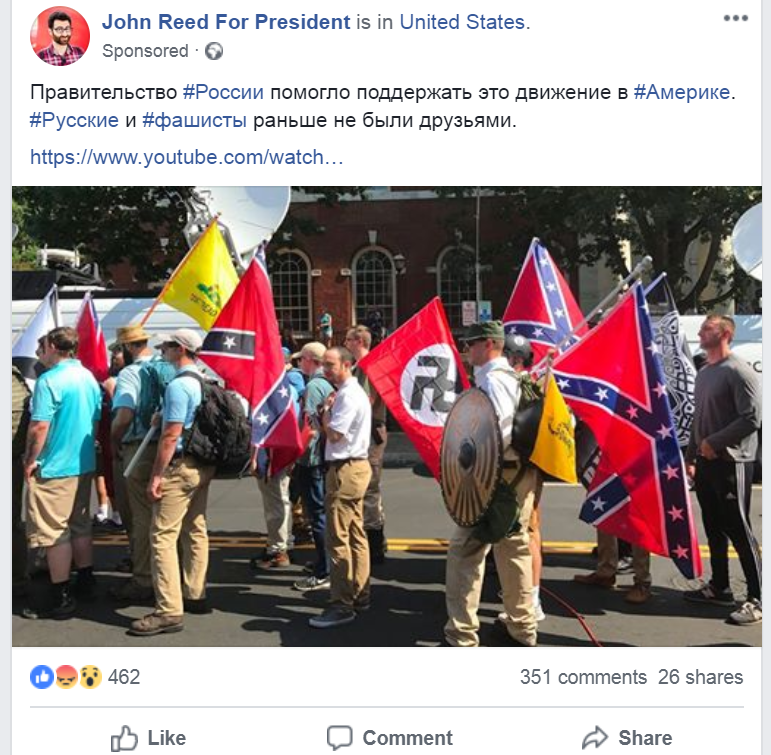
The other day, my Moscow resident friend sent me this “Sponsored” content that appeared on his Facebook page…

50969831_293950258142047_2975410208588693504_n.png
“The Russian government helped support this movement in America. Russians and fascists haven’t been friends before”

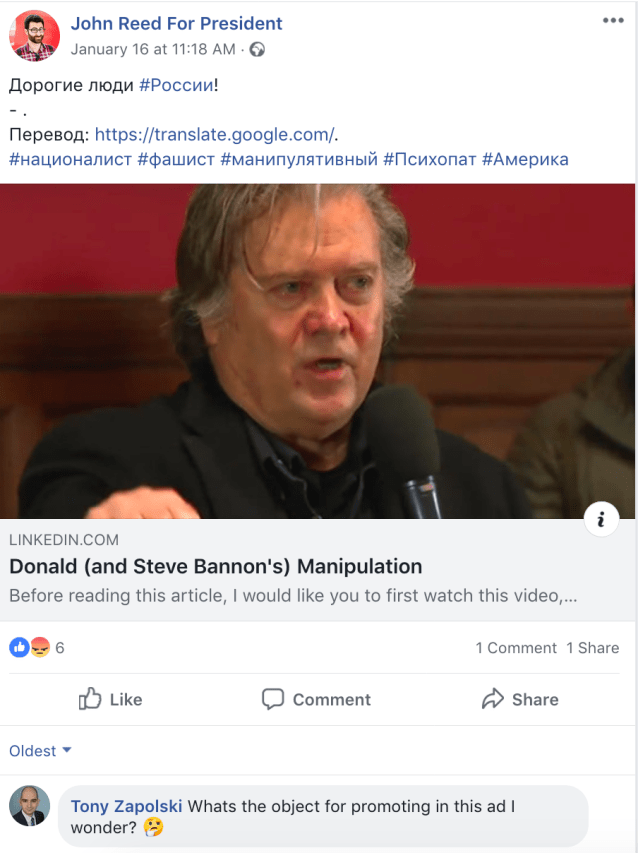
Honestly, somebody spent money to promote this piece of crap in Moscow? I wonder, is the man OK in the head? It looks like it isn’t the only post he promoted to Russians…


Screenshot 2019-01-20 at 23.37.27.png
Dear people of Russia! Translation: @google; nationalist, fascist, manipulative, psychopath, America.

This John Michael Reed appears to be suffering from a serious case of Russiagateism, and Trump derangement syndrome, and should get professional help.

Newly-formed Orthodox Church in Ukraine was Recognised by Uniates and the LGBT

Translated from Fraza.ua.

Not a single one of local Orthodox Churches has sent her greetings to the “unifying council”, and the Orthodox Church in Ukraine (OCU) that was formed there. Meanwhile, as the journalists from Fraza found out, the OCU was recognised by the US State Department, the LGBT community, and the Ukrainian Greek Catholic Church (what I call “Uniates“). The Vatican has at first recognised the Church but then refused to recognise it.

Expert on religions, Alexandr Voznesensky wrote that the LGBT community recommends the newly-formed “unified Church” under the leadership of Epiphanius. The expert added: “This is what I understand as World recognition. After this, recognition of local Churches is not needed.”

000.jpg
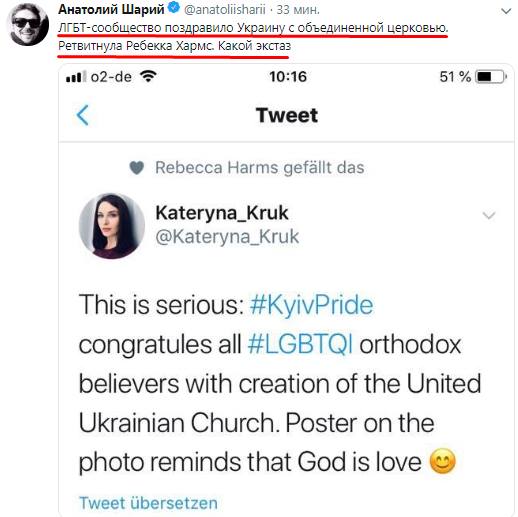
Anatoly Shariy (red underscored text above): The LGBT community have greeted Ukraine with the unifying council. Rebecca Harms (German EMP) retweeted, what an ecstasy.

TASS reports that in the opinion of the Deputy Spokesperson under the leadership of the 70th Secretary of State, Mark Pompeo, Robert Palladino, “the creation of this Church is a historic event for Ukraine.” He greeted, in the name of United States, the head of OCU, “metropolitan” Epiphanius with being elected. 48366708_1941863119195296_3816984762199834624_n.jpg

Today (the article was published on 18 of December 2018), the press secretary of OCU, Eustratius (Zorya) announced that a report, which has appeared on the Vatican website, which spoke about the election of Epiphanius, de facto means the Pope has recognised has recognised the Church. He wrote: “It is de facto a sign, that in accordance with the order of  the ecumenical dialogue with the Orthodox Churches, by the power of the canonical recognition by the Ecumenical Patriarch Bartholomew of the Ukrainian Church and her Metropolitan, this Church acquired subjectness in the eyes of Rome.”

However, Zorya’s joy was premature. As it turned out, Vatican’s official portal did not recognise Epiphanius. This was announced on 18 December at the directorate of the Holy See’s press service.

The head of Ukrainian Greek Catholics (UGCC), Svyatoslav also sent greetings to supporters of the OCU in connection with the “unification council” and the election of a new representative. This was announced by the head of the pastoral service in Ukraine’s penitentiary system of the Patriarchal curia of the UGCC, Konstantin Pateley, on his Facebook page.

Here are the Maps I was Talking About

Dear readers, never mind the title. This is a post for a friend in Kiev that I Skype with, and this was a subject of our last talk. I hope the rest of you will enjoy it as well, although this will be familiar to some readers from Russia-Ukraine debates on Anatoly Karlin’s blog.

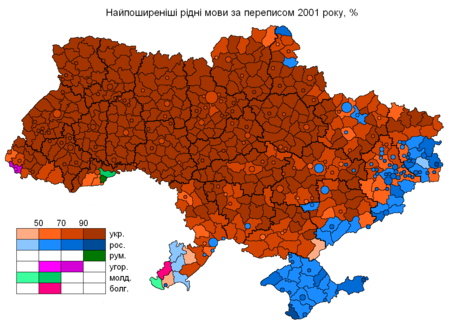
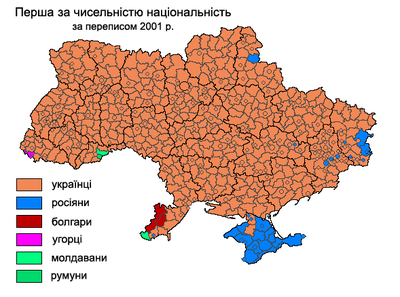
I was telling him about maps based on the 2001 census (Ukraine did not conduct a census for 18 years now), which eerily seem to copy Russia’s 2014 territorial acquisitions, official (Crimea), and unofficial (Donbass Republics). The map shows Russia only took the areas where the “Russian cultural element” was predominant, places where people identified themselves as ethnic Russians, and their native language as Russian. I provide translation underneath the pictures. You can also see that in the Donbass, the Russian element appears weaker than in Crimea. Maybe it is this what Zatulin means when he says that the people of Donbass are not Russian enough? But it would have been better if he kept his autistic opinions to himself.

Anyway, Here is what I meant when I said Russia’s territorial interests in Ukraine appear “ethnically motivated.”

Nativelanguage2001ua.png
The most commonly declared native language according to the 2001 census. Russian is marked in blue.

400px-UaFirstNationality2001.png
The majority nationality in the given district. Russians are again marked in blue.

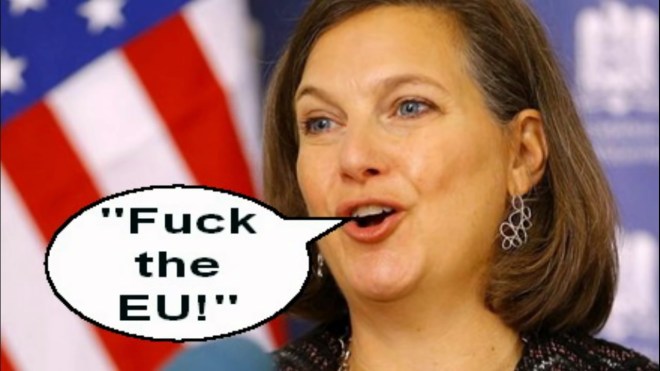
I Declare Operation: “Fuck the EU!”

Attention, fellow citizens of the Union!

maxresdefault-2.jpg

I have never voted in the European Parliament elections but seeing that certain characters that I do not like are very worried about its outcome, I decided to cast a ballot this May. What prompted my decision was an insidious article in The Wired magazine, which claims the EU elections may be hacked. The homosexual pornstar hero of this blog, Jakub Janda is quoted saying:

“If you have lower turnout, it’s much easier to focus on specific electoral groups favouring the far-right and mobilise them to a greater effect,” says Jakub Janda, the Prague-based executive director of the European Values think tank, which maintains a Russian-interference monitoring arm.

He basically gave a blueprint here, we should not ignore the election and vote the “far-right”, or whatever Eurosceptic there is on the ballot. They are all “far-right” to the globalists. The EU supports literal fascists in Ukraine, so they might be cool with few in the European Parliament. There might be several individuals vying for office with varying chances of success. But I have figured out a way to make the right choice.

Vote for the one party which worries your local globalist elite the most.  The Czech Socialist Minister of Foreign Affairs, Tomáš Petříček worries about SPD for instance. He says the party is a danger to Europe’s liberal democracy. I don’t know what’s more undemocratic than the EU but I guess people who are a danger to liberal democracy would fit right in.

SPD is anti-immigration and supports direct democracy, Swiss style. I would never vote for them in Czech parliamentary elections because I do not trust their leader, who is a hapa businessman, Tomio Okamura. But if Petříček says I shouldn’t vote for them, well I will vote for them. Unless of course, a better candidate comes along.

Ukrainians Weren’t Around in 1850s

Even in Western Ukraine…

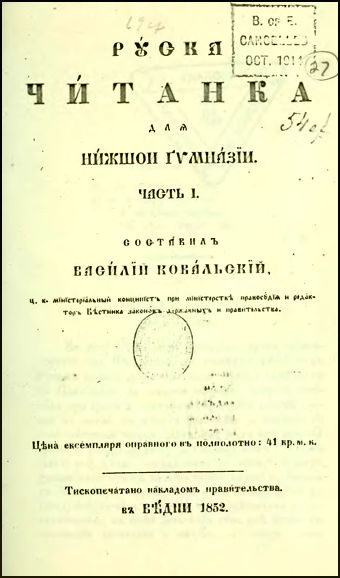
Dwx3pTrXQAARC27.jpgWhat you see to your right is a page from the Ruska Chitanka, in translation “Russian Reader” edited by Vasily Kovalsky. It has been circulating around Ukrainian nationalist Twitter pages, and the name caught my eye. It was published in Vienna in 1852. Kovalsky was a professor at Lvov university, and the book was likely intended to teach literacy to school children.

What it show is that in 1850s, the people in Western Ukraine did not think of themselves as Ukrainians. In fact, many did not think of themselves as Ukrainians all the way into the first half of the twentieth century. A town in Western Ukraine is still named Rava Ruska, which reminds us of those days.

So what happened? Nationalism happened! Somewhere in the latter part of the nineteenth century, activists in Western Ukraine adopted the ethnomyn “Ukrainian”, which was invented by Polish intellectuals. And thus, Ukrainian nationalism began.

I have another book on my shelf, it is called Obrazy z Rus, that is “Images of the Russias”, written by the Czech nationalist Karel Havlíček Borovský. Russias is in the plural because the author means: “Little, Greater, and White Russia”. He clearly doesn’t see a difference in ethnicity between the inhabitants of these lands. In his discussion of Russian culture, he goes into a lengthy description of a Little Russian Cossack, and does not make a difference between his behaviour and the behaviour of people in Greater Russia.

Therefore, Ukrainian nationalism is an ideology, which seeks to alienate an invented community called Ukrainians from their kin. The Ukrainian nation is literally little more than 100 years old. Therefore, when we talk about Ukrainian history, it is this story of how Ukrainians came into being that ought to be the main topic. Any pretences to the history of Medieval Rus’, the Cossacks, the Haydamaks are but historical usurpations.

Russia Doesn’t Need Russophobic Ukraine

Every time the Poroshenko administration does something to alienate his country from Russia, he utters words that have now become a meme. In English they sound like: “I once again say goodbye to the Russian Empire.” And every time he says good bye, some hack declares “Putin, Russia, Russia’s imperialist ghost  has lost” Ukraine. The problem is, Russia doesn’t own Ukraine and did not since 1991. Hence, the Russians had limited influence over Ukraine. And even if I think Russia could be more active in dealing with Ukraine before 2014, it is questionable whether Russia would have won this fight against the West.

Basically, Ukraine as it exists now is virtually useless to Russia. Crimea is Russia, forever. The Nord Stream 2 will be constructed soon enough. Any resources Russia needs can easily be bought from the Ukrainian oligarchs. Russia also accepts immigrants from Ukraine, making use of her human capital. Since Ukraine, already under Yanukovych, refused to join a grain cartel proposed by Russia, Ukraine has become a competitor to Russia in the agricultural sphere.

Russia does not need an agricultural superpower with Russophobic hillbillies. We have seen the capability of Ukraine to wage war in the cauldrons of Donbass and the strait of Kerch. But look on the map, Russia and Ukraine are part of one geographical space. One day hopefully the government in Ukraine will change. And until then, we will have the current situation.